Disclaimer: This blog post is intended for informational purposes only and does not constitute legal, financial, visa, or medical advice. Please consult with a qualified professional for advice tailored to your specific situation.
As a female small business owner in Australia, truly understanding the value of your time is the single most powerful lever you have for growth, sanity, and sustainability. In 2026, with over half a million women leading small businesses, it’s time to stop undervaluing ourselves and start making every hour count.

Introduction: The Real Cost of “Just an Hour” – A Conversation We Need to Have
Hello, brilliant businesswoman!
If you’re reading this, you’re probably juggling a dozen roles—CEO, bookkeeper, marketer, customer service rep, and maybe even chief coffee-maker. Sound familiar? You’re not alone. In 2026, there are nearly 2.8 million businesses in Australia, and a whopping 97.3% of them are small businesses just like yours. Even more inspiring: over half a million of these are owned or led by women—women who, like you, are rewriting the rules of business every single day.
But let’s get real for a moment. How often do you find yourself saying, “It’s just an hour, I’ll do it myself”? Whether it’s wrangling your inbox, chasing invoices, or updating your website, those “just an hour” tasks add up. And here’s the kicker: most of us are systematically undervaluing what that hour is truly worth to our business—and to ourselves.
Today, I want to walk you through the real, data-backed cost of your time as a small business owner in Australia. We’ll bust some myths, crunch some numbers, and give you practical tools to reclaim your hours for what matters most. Ready? Let’s dive in.
The Landscape: Australian Small Business in 2026
Before we get into formulas and frameworks, let’s ground ourselves in the reality of small business in Australia right now:
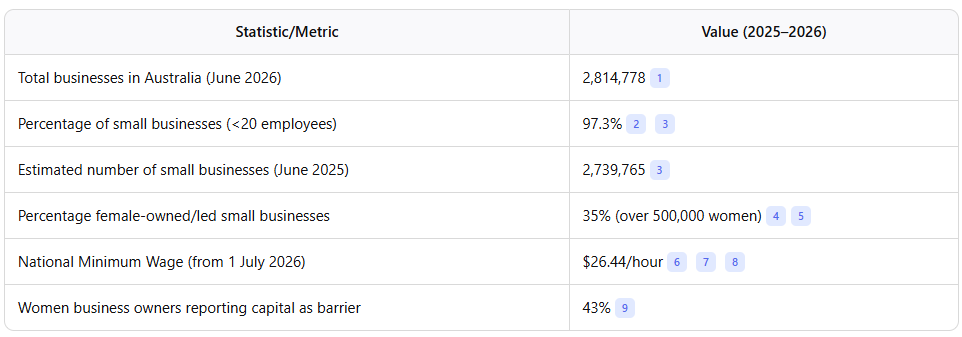
That’s a lot of us, and we’re making a huge impact. But we’re also facing unique challenges—especially when it comes to time and money. In fact, 43% of women business owners say that access to capital is a major barrier. That means every hour you spend needs to be working as hard as you are.
Why Do We Systematically Undervalue Our Time?
Let’s be honest: most of us started our businesses because we’re passionate, skilled, and maybe a little bit stubborn. We’re used to rolling up our sleeves and getting things done. But somewhere along the way, many of us fall into the trap of thinking our time is “free”—especially when we’re not directly billing a client for it.
Here’s why this mindset is so common (and so dangerous):
We’re conditioned to be “helpers.” Many women are socialised to put others first, to be “nice,” and to avoid charging what we’re worth.
We confuse being busy with being productive. If our calendar is full, we must be succeeding, right? Not necessarily.
We underestimate the hidden costs. Every hour spent on admin is an hour not spent on growth, strategy, or self-care.
We feel guilty about delegating. There’s a persistent myth that “no one does it like me,” or that outsourcing is a luxury.
But here’s the truth: undervaluing your time is one of the fastest ways to burn out and stunt your business’s growth. Let’s change that—starting now.
The True Hourly Rate Formula: What Is Your Time Really Worth?
Let’s get practical. If you only remember one thing from this post, let it be this formula:
True Hourly Rate = (Desired Annual Income + Business Overheads) / Billable Hours per Year
This formula is your new best friend. It tells you, in black and white, what every working hour needs to be worth for your business to thrive.
Step-by-Step: Calculating Your True Hourly Rate
Let’s walk through a real-world example, using Australian dollars and 2026 figures.
1. Desired Annual Income
What do you want to pay yourself? Be honest—this isn’t about scraping by, it’s about what you deserve for your expertise and effort. Let’s say you want to earn $120,000 per year.
2. Business Overheads
Add up all your annual business expenses: rent, software, insurance, marketing, professional development, etc. For this example, let’s use $30,000.
3. Billable Hours per Year
How many hours do you actually spend on client work or revenue-generating activities? Be realistic—after holidays, admin, and business development, most small business owners average 1,200 billable hours per year (that’s about 25 hours per week over 48 weeks).
4. Plug It In
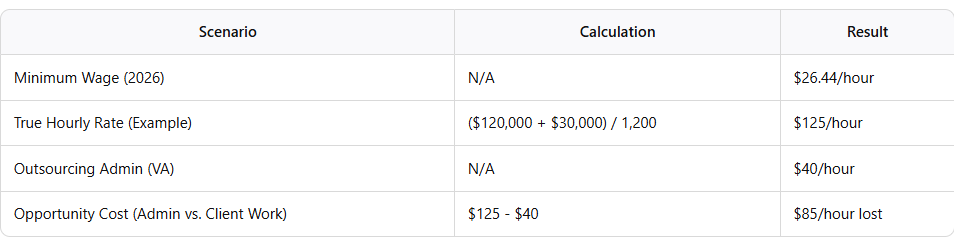
True Hourly Rate = ($120,000 + $30,000) / 1,200 = $125 per hour
That’s right: your time is worth $125 per hour.
5. Compare to Minimum Wage
For context, the national minimum wage in 2026 is $26.44 per hour —less than a quarter of your true rate. If you’re spending your precious hours on tasks that could be outsourced for less, you’re leaving money (and sanity) on the table.
Have you checked out all the new tools, guides and checklists in our Resource Hub? Explore and download now!
Opportunity Cost: The Hidden Price Tag on Every Decision
Now, let’s talk about a concept that’s a game-changer for business owners: opportunity cost.
What Is Opportunity Cost?
Opportunity cost is the value of the next best alternative you give up when you choose one option over another. In business, it’s not just about what you spend—it’s about what youmiss out onby not spending your time or money differently.
The Formula
Opportunity Cost = Return on Best Foregone Option – Return on Chosen Option
Practical Example: The Admin Trap
Let’s say you spend an hour reconciling your accounts—a task you could outsource for $40 per hour. If you had spent that hour on client work billed at your true hourly rate ($125), your opportunity cost is:
Opportunity Cost = $125 (client work) – $40 (admin outsourcing) = $85
That’s $85 lost—not just in potential income, but in momentum, growth, and energy.
Billable Rate vs. Cost Rate: Know the Difference
It’s easy to confuse what you charge with what your time costs your business.
Billable Rate: What you invoice clients for your time (e.g., $150/hour).
Cost Rate: The actual cost to your business for each hour you work, including your salary, overheads, and opportunity costs.
If your billable rate is less than your cost rate, you’re effectively paying to work. Ouch.
Time Audit: Where Does Your Time Really Go?
Before you can optimise your hours, you need to know where they’re going. Enter the time audit.
How to Do a Time Audit
Track Everything: For one week, write down every task you do and how long it takes.
Categorise: Label each task as high-value (directly generates revenue or growth) or low-value (admin, routine, or could be delegated).
Analyse: What percentage of your time is spent on high-value vs. low-value tasks?
Example Table
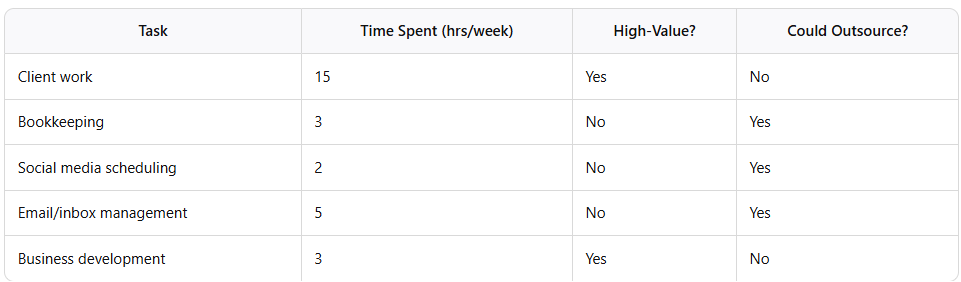
If you’re spending more than 30–40% of your week on low-value tasks, it’s time to rethink your workflow.
The Real Cost of Doing Low-Value Tasks Yourself
Let’s put some numbers to it. If your true hourly rate is $125, and you spend 10 hours a week on admin, that’s $1,250 per week—or $65,000 per year—in lost value.
Key Finding:
Every hour you spend on tasks that could be outsourced for $30–$50 is an hour you’re paying a premium for, without the return.
Common Low-Value Tasks
Bookkeeping and data entry
Social media scheduling
Inbox and calendar management
Basic website updates
Chasing invoices
These are all important—but they don’t require your unique expertise.
Delegation and Outsourcing: The Smart Business Owner’s Secret Weapon
Here’s a simple decision framework:
Outsource if the cost of outsourcing is less than the opportunity cost of your time.
How to Decide
Calculate your true hourly rate.
Get quotes for outsourcing (e.g., virtual assistant, bookkeeper).
If outsourcing costs less than your rate, delegate!
Example
Your true hourly rate: $125
Virtual assistant rate: $40/hour
Opportunity cost of doing it yourself: $85/hour
Result:
Outsource and reclaim your time for high-value work.
Tools to Help You Automate and Delegate
You don’t have to do it all alone. In 2026, there are more tools than ever to help you streamline, automate, and delegate:
Xero & MYOB: Cloud-based accounting to automate invoicing, payroll, and reconciliation.
Asana & Trello: Project management to keep your team (and yourself) on track.
Canva: Easy, professional design for social media and marketing.
Online business management services: Like mine! We specialise in helping female business owners reclaim their time and focus on what matters.
The Emotional Barriers: Guilt, Perfectionism, and “No One Does It Like Me” Syndrome
Let’s get vulnerable for a moment. For many women, the biggest barrier to valuing our time isn’t financial—it’s emotional.
Guilt: “If I delegate, am I being lazy or selfish?”
Perfectionism: “No one will do it as well as I do.”
Control: “If I let go, something will fall through the cracks.”
Sound familiar? You’re not alone. But here’s the truth: your business (and your wellbeing) will thrive when you focus on your zone of genius and let others support you.
Key Takeaway:
Delegation isn’t a sign of weakness—it’s a sign of leadership.
Action Plan: Calculate Your True Hourly Rate and Do a Time Audit
Ready to take action? Here’s your step-by-step plan:
1. Calculate Your True Hourly Rate
Add up your desired annual income and business overheads.
Estimate your billable hours per year.
Use the formula:
(Desired Annual Income + Overheads) / Billable Hours = True Hourly Rate
2. Do a One-Week Time Audit
Track every task and how long it takes.
Categorise as high-value or low-value.
Identify tasks to delegate or automate.
3. Identify Your Opportunity Costs
For each low-value task, calculate the difference between your true hourly rate and the cost to outsource.
Prioritise delegating tasks with the highest opportunity cost.
4. Choose One Task to Delegate or Automate This Month
Start small. Pick one task (e.g., bookkeeping, social media scheduling) and find a trusted provider or tool.
5. Review and Adjust Quarterly
Revisit your time audit and hourly rate every quarter.
As your business grows, your time becomes even more valuable—adjust accordingly.
Empowering You to Lead, Not Just Manage
If you take nothing else from this post, remember this: your time is your most valuable asset.
Every hour you spend should be moving you closer to your goals—whether that’s growing your business, spending time with family, or simply taking a well-deserved break.
In 2026, with over half a million women leading small businesses in Australia, we have the power to redefine what success looks like. It starts with valuing ourselves, our expertise, and our time.
A Gentle Invitation: Let’s Make Every Hour Count—Together
If you’re ready to reclaim your time, boost your profits, and build a business that works foryou, I’d love to help. As an online business management specialist, I work with female small business owners across Australia to streamline operations, delegate with confidence, and plan strategically for growth.
Summary Table: Your Hourly Rate at a Glance

Final Thoughts
You are the heart and soul of your business. Your time is precious, powerful, and worthy of respect—by you, your clients, and your team. Don’t let another year go by undervaluing what you bring to the table.
Here’s to making every hour count, building businesses that serve us (not the other way around), and supporting each other as we rise.
Take the First Step:
Calculate your true hourly rate today. Your future self—and your business—will thank you.
Ready to take your business knowledge to the next level? Book a strategy session with me, join our community of female founders.
There are many ways of working with professionals. Start small, but keep it regularly and don’t wait until something happens. Strategic planning and periodic reviews are a great start to implement those strategies.
Perfectly Organised NT can assist with a financial review and strategic business planning & management. Find out more!

Perfectly Organised NT - helping small business owners in Australia manage their business.