Starting with AI as a Small Business Owner in Australia: A 2026 Guide for Women Entrepreneurs
Disclaimer: This blog post is intended for informational purposes only and does not constitute legal, financial, visa, or medical advice. Please consult with a qualified professional for advice tailored to your specific situation.
AI is no longer just for tech giants—it's a practical, affordable, and empowering tool for Australian women running small businesses. With beginner-friendly options, government support, and real-world benefits, now is the perfect time to start your AI journey.

Introduction: Why AI, Why Now?
If you’d told me five years ago that artificial intelligence (AI) would become as essential to running a small business as email or a mobile phone, I might have raised an eyebrow. But here we are in 2026, and AI is not just a buzzword—it’s a genuine game-changer for Australian small business owners, especially women like us who juggle a million roles every day.
I’m the founder of an online business management consultancy dedicated to helping female entrepreneurs across Australia. Every week, I see firsthand how AI is transforming the way we work: from automating admin headaches to supercharging marketing, and even helping us reclaim precious time for family, creativity, or just a well-earned break.
But I also know that “AI” can sound intimidating—like something for Silicon Valley, not for a florist in Fremantle or a bookkeeper in Ballarat. That’s why I’ve written this guide: to demystify AI, show you how easy it is to get started, and help you take your business to the next level, step by step.
The Australian Small Business Landscape in 2026
Let’s start with some context:
Small businesses are the backbone of Australia: 97.3% of all Australian businesses are small businesses, and there are nearly 2.73 million of us as of 2025.
Women are leading the way: One in three Australian businesses is led by a woman, and the number is rising fast. In fact, two-thirds of new businesses in the past decade were founded by women.
AI adoption is growing: Around 33–40% of Australian small and medium enterprises (SMEs) have already adopted some form of AI, especially in metro areas. But only about 5% have fully integrated AI into their workflows—meaning there’s still huge untapped potential.
Key Finding:
Australian women are starting businesses at record rates, but many are still missing out on the productivity and growth benefits that AI can offer.
What Is AI, Really? (And Why Should You Care?)
AI, at its core, is about using smart software to do things that used to require human intelligence—like writing, analysing data, answering questions, or even chatting with customers. But you don’t need to be a coder or a tech whiz to use it. Today’s AI tools are designed for real people, with drag-and-drop interfaces, plain English instructions, and (best of all) free or low-cost plans.
Why should you care?
Because AI can help you:
Save hours every week on repetitive tasks
Improve your marketing and customer service
Make smarter, data-driven decisions
Compete with bigger businesses—without a big budget
Beginner-Friendly AI Tools: What’s Out There in 2026?
Let’s break down the most popular, beginner-friendly AI tools for Aussie small businesses. I’ll focus on the ones I recommend most to my clients: ChatGPT, Claude, and Google Gemini. I’ll also touch on a few others that are worth knowing about.
1. ChatGPT (OpenAI)
What it does: Drafts emails, writes blog posts, answers questions, summarises documents, generates ideas, and more.
Why I love it: It’s like having a super-smart assistant who never sleeps.
Pricing: Free tier (unlimited access to GPT-4o mini); Plus plan is $20 USD/month (~$30 AUD); Team and Business plans available.
Best for: Content creation, customer support, research, process optimisation.
Ease of use: Extremely beginner-friendly. If you can use Google, you can use ChatGPT.
2. Claude (Anthropic)
What it does: Handles long documents, writes policies and reports, analyses data, codes, and follows complex instructions.
Why I love it: It’s brilliant for nuanced writing and compliance-heavy tasks.
Pricing: Free tier (access to Claude 3.5 Sonnet with message limits); Pro plan is $20 USD/month (~$30 AUD).
Best for: Policy writing, legal/HR docs, deep analysis, coding.
Ease of use: Very intuitive, especially for business writing.
3. Google Gemini
What it does: Drafts documents, creates images, analyses data, integrates with Gmail, Docs, Sheets, and more.
Why I love it: Seamless for anyone already using Google Workspace.
Pricing: Free tier (Gemini 2.5 Flash, limited Pro features); Advanced plan is $19.99 USD/month (~$30 AUD).
Best for: Document drafting, meeting notes, research, workflow automation.
Ease of use: If you use Gmail or Google Docs, you’ll feel right at home.
4. Other Handy AI Tools
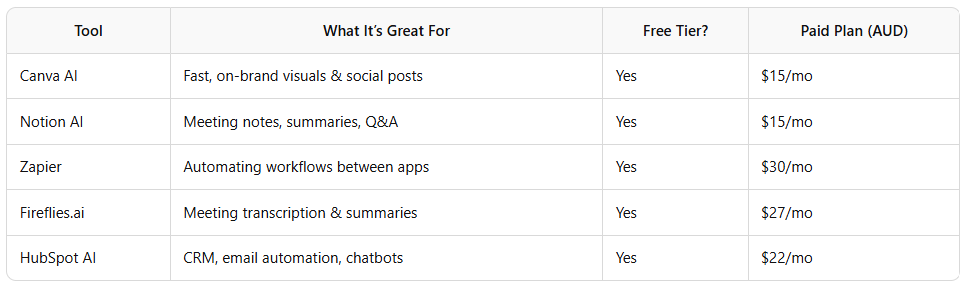
Pro Tip:
Most of these tools offer genuinely useful free plans. You can try them out without spending a cent.
Have you checked out all the new tools, guides and checklists in our Resource Hub? Explore and download now!
Real-World Use Cases: How AI Can Help Your Business Today
Let’s get practical. Here are the most common ways my clients use AI—plus step-by-step guidance to get you started.
1. Drafting Emails and Social Media Content
Scenario:
You need to send a client update or post on Instagram, but you’re short on time (or inspiration).
How to do it with ChatGPT or Claude:
Sign up for a free account at chat.openai.com (ChatGPT) or claude.ai (Claude).
Type your prompt:
“Write a friendly email to a client updating them on their project status.”
“Draft a social media post for my handmade jewellery business about our new collection.”
Review and edit: The AI will generate a draft in seconds. Tweak it to match your voice.
Copy and send/post: Done!
Time investment:
5–10 minutes per task.
2. Summarising Meeting Notes
Scenario:
You’ve just finished a Zoom call and need to send out action items.
How to do it with Fireflies.ai or Notion AI:
Connect Fireflies.ai to your calendar or video call platform.
Record your meeting: Fireflies will automatically transcribe and summarise it.
Review the summary: Edit as needed, then share with your team.
Time investment:10–15 minutes (setup is a one-time 10-minute process).
3. Automating Repetitive Tasks
Scenario:
You’re tired of manually copying new leads from your website into your email list.
How to do it with Zapier:
Sign up for a free Zapier account.
Choose your trigger: e.g., “When someone fills out my website contact form…”
Choose your action: e.g., “…add them to my Mailchimp email list.”
Test and activate: Zapier will automate this process from now on.
Time investment:20–30 minutes for your first automation.
4. Creating On-Brand Visuals
Scenario:
You need a professional-looking flyer or Instagram post, but don’t have a designer.
How to do it with Canva AI:
Sign up for Canva (free plan available).
Use Magic Write or Magic Design: Type what you need (“Create a flyer for a Mother’s Day sale”).
Customise: Drag and drop elements, change colours, add your logo.
Download and share: Ready to go!
Time investment:10–20 minutes per design.
5. Research and Analysis
Scenario:
You want to understand your competitors or summarise a long industry report.
How to do it with Claude or Gemini:
Upload the document or paste the text into Claude or Gemini.
Ask for a summary: “Summarise the key points of this report.”
Ask follow-up questions: “What are the main trends affecting my industry?”
Time investment:5–15 minutes per document.
How Time-Intensive Is AI Setup, Really?
This is one of the most common questions I get. The good news: most beginner AI tools can be set up in under 30 minutes.
Here’s what to expect:
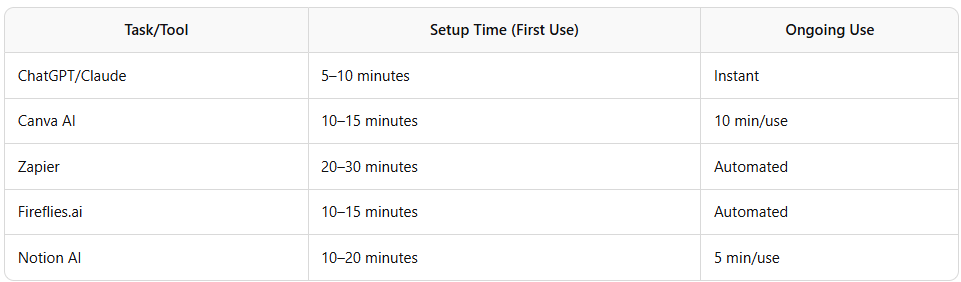
Key Takeaway:
You don’t need to block out a whole weekend to get started. Most tools are plug-and-play, with helpful tutorials and support.
What’s Next? Level Up with Automation, Integrations, and AI Agents
Once you’re comfortable with the basics, you can unlock even more value by moving to the “next level” of AI adoption.
Here’s what that looks like:
1. Workflow Automation
What it is: Connecting multiple tools so they work together automatically (e.g., new client signs up → welcome email sent → invoice generated → CRM updated).
How to do it: Use platforms like Zapier, Make, or n8n to build custom workflows. No coding required—just drag, drop, and set your rules.
Time investment: 1–2 hours for your first complex workflow; gets faster with practice.
2. AI Agents
What they are: AI-powered assistants that can handle multi-step tasks, like qualifying leads, following up with customers, or even managing your calendar.
How to do it: Tools like MindStudio or Claude Cowork let you build custom agents tailored to your business needs.
Time investment: A few hours to set up; ongoing tweaks as your business evolves.
3. Custom Integrations
What it is: Tailoring AI tools to your unique business processes—connecting your website, CRM, email, and more.
How to do it: Many tools offer “integration marketplaces” or work with platforms like Zapier.
Time investment: Varies by complexity; start small and build up.
Pro Tip:
Don’t try to automate everything at once. Start with your biggest pain point, automate that, and build from there.
Australian-Specific Considerations: What You Need to Know
1. Data Privacy and Compliance
Privacy Act 1988: If you’re collecting or processing personal information (e.g., customer emails, payment details), you must comply with the Privacy Act. Most reputable AI tools have privacy settings and data handling policies—always check these before uploading sensitive data.
Australian Consumer Law: Any AI-powered customer interactions (like chatbots) must be fair, transparent, and not misleading.
GST/BAS Compliance: If you use AI for accounting or invoicing, make sure the tool supports Australian tax requirements.
2. Government Support and Resources
AI Adopt Program: The Australian Government is investing millions in helping SMEs adopt AI, including funding for AI Adopt Centres and upskilling workers.
National AI Centre (NAIC): Offers guidance, resources, and an AI Adoption Tracker to help you understand and implement AI safely.
Targeted Grants: Over $362 million in grants are available for AI and digital capability—check business.gov.au for the latest opportunities.
Key Finding:
Australia is committed to helping small businesses (especially women-led ones) harness the power of AI, with practical support and funding available.
My Personal Thoughts: Why I Believe in AI for Women in Business
I’ve worked with hundreds of female entrepreneurs across Australia—from solo consultants to growing teams.
Here’s what I’ve learned:
AI is an equaliser: It lets small businesses punch above their weight, compete with bigger players, and focus on what matters most.
You don’t need to be “techy”: The best AI tools are designed for real people. If you can use email, you can use AI.
Start small, grow fast: The biggest wins come from solving your most annoying problems first—like automating admin or speeding up content creation.
Community matters: Don’t go it alone. Join online groups, attend workshops, and share your experiences. The more we learn together, the stronger we become.
Empowering Insight:
AI isn’t about replacing people—it’s about freeing us to do more of what we love, and less of what drains us.
Frequently Asked Questions
Q: Is AI expensive?
A: Most tools have free plans, and paid plans start around $20–$30 AUD/month. You can get real value without breaking the bank.
Q: Will AI take over my job?
A: No! AI is a tool to help you work smarter, not harder. It handles the boring stuff so you can focus on strategy, creativity, and relationships.
Q: Is my data safe?
A: Stick to reputable tools, read their privacy policies, and avoid uploading sensitive information unless you’re sure it’s secure.
Q: How do I get started?
A: Pick one tool (like ChatGPT or Canva AI), sign up for a free account, and try it on a real task. You’ll be amazed at how easy it is.
Summary Table: AI Tools at a Glance


Empowering Call to Action
Ready to get started?
You don’t need to be a tech expert, have a big budget, or wait for the “perfect” time. AI is here, it’s accessible, and it’s designed for women like you—smart, resourceful, and ready to take your business to the next level.
Here’s your action plan:
Pick one AI tool from the list above.
Try it on a real business task—draft an email, automate a process, or create a social post.
Join a community of women in business (online or in-person) to share tips and support.
Explore government resources like the AI Adopt Program and National AI Centre.
Celebrate your wins—no matter how small. Every step forward is progress.
If you need help, reach out! I’m always here to support fellow women in business on their AI journey.
Final Thought:
AI isn’t the future—it’s the present. And it’s yours to shape. Let’s build smarter, stronger, and more joyful businesses together.
There are many ways of working with professionals. Start small, but keep it regularly and don’t wait until something happens. Strategic planning and periodic reviews are a great start to implement those strategies.
Perfectly Organised NT can assist with a financial review and strategic business planning & management. Find out more!

Perfectly Organised NT - helping small business owners in Australia manage their business.