Further Education as a Small Business Owner in Australia
Disclaimer: This blog post is intended for informational purposes only and does not constitute legal, financial, visa, or medical advice. Please consult with a qualified professional for advice tailored to your specific situation.
Further education is more accessible, flexible, and impactful than ever for Australian small business owners—especially women. Whether you’re considering a new degree, a short course, or a stack of micro-credentials, there’s a pathway that fits your business, your life, and your ambitions.

Introduction: Why Further Education Still Matters (and How It’s Changed)
If you’d told me a decade ago that I’d be writing this blog post in 2026, running an online business management consultancy for female small business owners, I might have laughed. Back then, “further education” meant either going back to uni for years or squeezing in a night class at TAFE after a long day. Fast forward to today, and the landscape has transformed—education is now as flexible and diverse as the women I work with every day.
As a business owner, you’re constantly learning on the job. But there comes a point where you crave more: sharper skills, fresh ideas, or simply the confidence that comes from knowing you’re up to date. Whether you’re looking to scale, pivot, or just keep your business humming, further education can be the game-changer.
But what does “further education” really mean in 2026? Is it worth doing another degree? Are short courses enough? What about all those online micro-credentials? And how do you fit study into a life already bursting at the seams?
Let’s dive in—this is your comprehensive, no-nonsense guide to further education as a small business owner in Australia, with a special focus on the unique needs and opportunities for women.
Should You Do Another University Degree? The Big Question
The Case for (and Against) a New Degree
Let’s start with the elephant in the room: Is it worth going back to university for another degree as a business owner?
Here’s the honest truth:
A full degree—whether it’s an MBA, a Bachelor of Business, or a Graduate Certificate—can be a powerful lever. It can open doors, build networks, and give you a deep, structured understanding of business. But it’s also a major investment of time, money, and energy. For many women juggling business, family, and life, it’s not always the right move.
When a Degree Makes Sense
You want to pivot into a new field (e.g., from retail to consulting, or from solopreneur to corporate board member).
You’re aiming for advanced leadership roles (think board positions, C-suite, or large-scale business growth).
You crave a formal, comprehensive education—the kind that covers strategy, finance, leadership, and innovation in depth.
You value the network and credibility that comes with a top-tier university brand.
When It Might Not
You need practical skills, fast.
You’re already stretched thin and can’t commit to years of study.
Your business needs targeted upskilling (e.g., digital marketing, financial management) rather than a broad curriculum.
You prefer learning in bite-sized, flexible ways.
The 2026 Degree Landscape: Flexible, Online, and Stackable
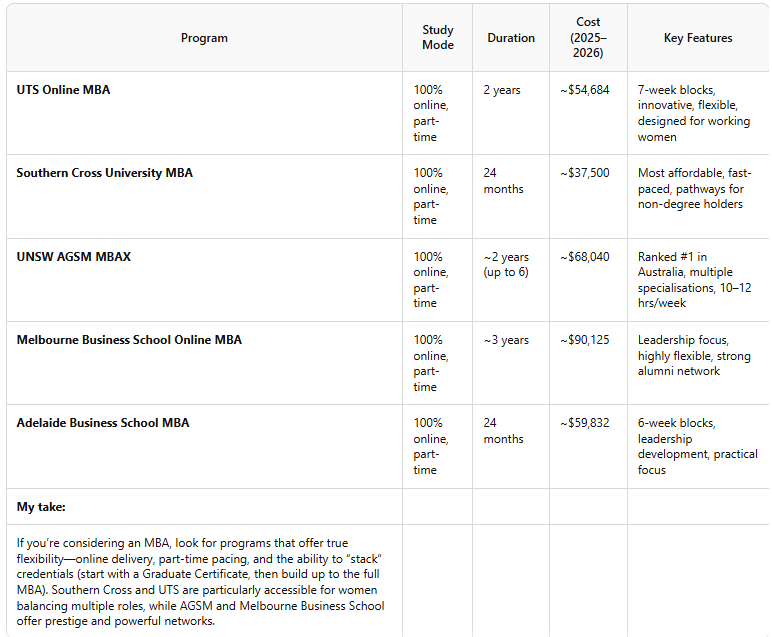
The good news? Degrees are more flexible than ever. Here’s a snapshot of what’s available right now:
Online and Part-Time MBA Programs
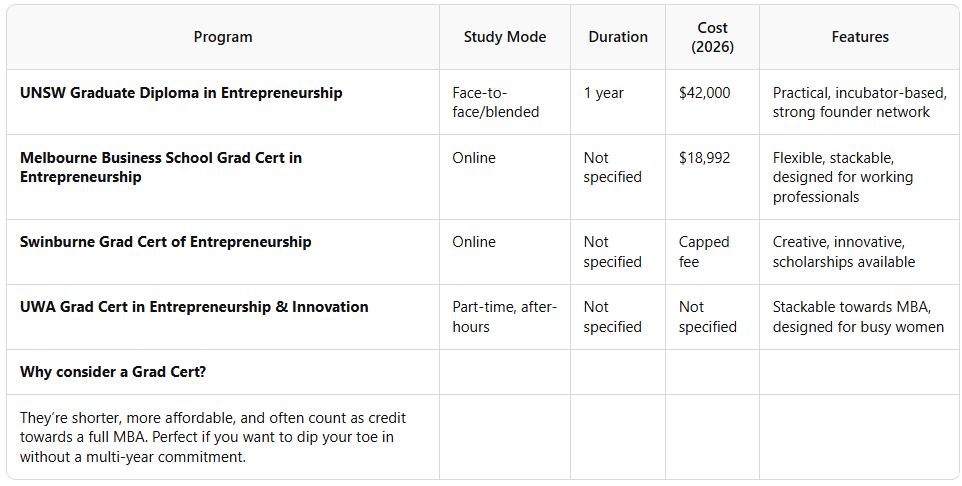
Graduate Certificates in Entrepreneurship & Business
Bachelor of Business (For Those Starting Fresh)

Funding Your Degree: FEE-HELP, Startup-HELP, and Scholarships
FEE-HELP: Government loan scheme for eligible students, covering tuition fees for most degrees.
Startup-HELP: Newer initiative supporting entrepreneurship-focused study.
Scholarships: Many universities offer scholarships for women, regional students, and underrepresented groups.
Pro tip:
Always check eligibility and repayment terms. And remember, you can often start with a Graduate Certificate and “stack” your way up to a full degree over time.
Shorter, More Accessible Options: Courses, Certificates, and Skill Sets
Not everyone needs (or wants) a degree. Sometimes, a targeted short course is exactly what your business needs.
TAFE Short Business Courses
Fee-free or subsidised in many states.
21 free TAFE NSW courses for small business owners (2026), covering business management, digital skills, compliance, and more.
Skill sets like “Operate a Small Business” available at TAFE SA, TAFE QLD, TasTAFE, and others.
Flexible delivery: Online, on-campus, or blended.
Why I love TAFE:
It’s practical, affordable, and designed for real-world business needs. Many of my clients have upskilled in bookkeeping, digital marketing, or leadership through TAFE short courses—often for free or at a fraction of the cost of private providers.
Industry Association Courses
Australian Institute of Company Directors (AICD) – Company Directors Course™
Duration: 5 weeks (one session per week)
Focus: Corporate governance, financial analysis, risk management, boardroom dynamics, leadership
Recognition: GAICD post-nominal, complimentary 12-month AICD membership (eligibility applies)
Cost: Discounted for ASBA members
Who is this for?
Women aiming for board roles, or wanting to seriously upskill in governance and leadership.
CPA Australia Program
Professional accounting qualification
Core subjects: Ethics, governance, strategic management accounting, financial reporting
Delivery: 100% online, flexible
Career pathways: Financial management, accounting, business leadership
Why consider CPA?
If you want to take control of your business finances—or even offer financial services to others—this is a gold-standard credential.
ASBAS Digital Solutions Program
Free or subsidised workshops, webinars, and one-on-one mentoring
Focus: Digital skills, business planning, compliance
Highly accessible: Especially for women new to digital business
Personal tip:
I recommend ASBAS to every client who feels overwhelmed by digital transformation. The support is practical, local, and often free.
Have you checked out all the new tools, guides and checklists in our Resource Hub? Explore and download now!
Online Learning Platforms & Digital Certifications: The Microlearning Revolution
If you’re like me, you love learning in bite-sized chunks—on your own schedule, at your own pace. Enter the world of online micro-credentials.
Major Platforms
Coursera, LinkedIn Learning, edX, FutureLearn:
Offer thousands of business, management, and digital marketing courses—including microcredentials and certificates from Australian universities.Delivery: 100% online, self-paced or instructor-led
Cost: Free to $500+ per course; many offer free introductory modules
Google Digital Garage:
Free digital marketing fundamentals and advanced certifications.
Meta Blueprint:
Free and paid courses on social media marketing, advertising, and analytics.
HubSpot Academy:
Free certifications in inbound marketing, content marketing, and CRM management.
Stacking Micro-Credentials:
My Honest View I’m a huge fan of “stacking”—building a portfolio of micro-credentials over time.
For example, you might combine:
A TAFE digital marketing skill set
A Google Analytics certification
A LinkedIn Learning course in leadership
A FutureLearn microcredential in business strategy
This approach is:
Flexible: Learn what you need, when you need it.
Affordable: Many courses are free or low-cost.
Practical: Immediate application to your business.
But:
If you’re aiming for a major career pivot or a high-level leadership role, a formal degree may still carry more weight. For most small business owners, though, a stack of targeted micro-credentials is often more valuable than a single, broad qualification.
Government Funding, Grants, and Tax Benefits: Making Education Affordable
One of the best things about being a small business owner in Australia right now? The sheer number of funding and support options for further education.
National Programs
JobTrainer:
Free or low-fee training in business management, digital skills, and entrepreneurship. Eligibility varies by state, but many small business owners qualify.
Skills for Education and Employment (SEE):
Free language, literacy, numeracy, and digital skills training for adults.
Self-Employment Assistance Program:
Financial support and business coaching for new and micro-business owners.
ATO Tax Deductions:
You can claim self-education expenses directly related to your business—course fees, textbooks, travel, and more.
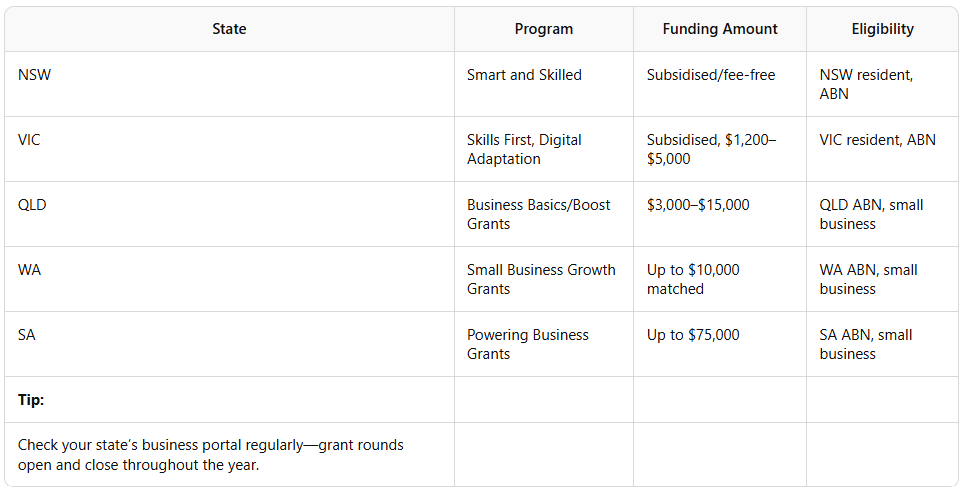
State-Based Subsidies and Grants
Programs for Female Entrepreneurs
Boosting Female Founders Initiative:
Federal grants for women-led startups and small businesses ($25,000–$480,000 per round, matched funding required).
Women’s Leadership and Development Program:
Supports projects advancing women’s leadership and economic security, including business education and mentoring.
COSBOA, Business Station Digital Solutions:
Subsidised training, mentoring, and digital skills programs with a focus on women and diverse founders.
Finding the Right Program
Use the business.gov.au Grants Finder for a personalised list of current programs.
Prepare your documentation: ABN, business plan, financials.
Seek advice: Free business advisory services can help with applications.
My Personal Reflections & Unique Ideas: Learning Beyond the Classroom
The Power of Micro-Learning Stacks
I’ve seen firsthand how building a “stack” of micro-credentials—short courses, digital badges, and certificates—can be just as powerful as a traditional degree. It’s about curating your own learning journey, tailored to your business’s real needs.
Peer Learning and Masterminds
Some of my most valuable learning has come from mastermind groups and peer networks. Sharing challenges, swapping resources, and holding each other accountable is a form of education you can’t get from a textbook.
Mentoring and Coaching
Don’t underestimate the value of a great mentor or coach. Whether it’s a formal program or an informal relationship, learning from someone who’s walked your path is priceless.
Industry Events and Conferences
In-person or virtual, these are goldmines for learning and networking. Many now offer on-demand recordings, so you can learn at your own pace.
Podcasts, Books, and Communities
Never underestimate the power of a good business podcast, a well-chosen book, or an active online community. These are the “hidden curriculum” of modern business education.
Aligning Education with Your Business Gaps
Before enrolling in anything, ask:
What’s the biggest gap in my business right now?
What skill or knowledge would have the highest ROI?
How will I apply what I learn—immediately?
The ROI Mindset
Think of education as an investment, not an expense. Will this course, degree, or credential help you:
Increase revenue?
Reduce costs?
Save time?
Open new markets?
Build confidence?
If the answer is yes, it’s probably worth it.
Time-Management Strategies for Studying While Running a Business
Block out “learning time” in your calendar—treat it like a client meeting.
Use micro-learning: 15–30 minutes a day adds up.
Leverage audio: Listen to lectures or podcasts while commuting or exercising.
Delegate or automate low-value tasks to free up study time.
Set clear goals: What do you want to achieve by the end of each course or module?
Practical Next Steps: Take Action Today
Key Finding:
The best time to invest in your learning was yesterday. The second-best time is today.
Here’s how to get started:
Identify your biggest business gap.
Is it digital marketing? Financial management? Leadership? Pick one area to focus on.Choose your learning format.
Do you need a deep dive (degree), a targeted skill (short course), or a quick win (micro-credential)?Check for funding and support.
Use the business.gov.au Grants Finder, check your state’s business portal, and talk to your accountant about tax deductions.Start small.
Enrol in a free or low-cost online course, attend a webinar, or join a mastermind group.Build your learning stack.
Over time, add new credentials, skills, and experiences to your portfolio.Share your journey.
Connect with other women in business—peer learning is powerful.

Conclusion: Your Education, Your Way
Further education as a small business owner in Australia has never been more accessible, flexible, or impactful. Whether you’re dreaming of an MBA, eyeing a TAFE short course, or stacking micro-credentials, there’s a pathway that fits your life and your business.
As women, we often put ourselves last—our clients, our families, our teams come first. But investing in your own learning is one of the best ways to serve everyone around you. It’s not selfish; it’s strategic.
So, what’s your next step? Maybe it’s enrolling in that free TAFE course, applying for a grant, or simply blocking out 30 minutes this week to learn something new. Whatever it is, take it. Your future self—and your business—will thank you.
You’ve got this. And if you ever need a cheerleader, a strategist, or just a fellow learner on the journey, you know where to find me.
Further Resources
Ready to take the next step? Drop a comment below or reach out for a strategy session—I’d love learning journey.
There are many ways of working with professionals. Start small, but keep it regularly and don’t wait until something happens. Strategic planning and periodic reviews are a great start to implement those strategies.
Perfectly Organised NT can assist with a financial review and strategic business planning & management. Find out more!

Perfectly Organised NT - helping small business owners in Australia manage their business.