The Solo Show: Managing Your Business Without a Team in 2026 as a Female, Small Business Owner
Disclaimer: This blog post is intended for informational purposes only and does not constitute legal, financial, visa, or medical advice. Please consult with a qualified professional for advice tailored to your specific situation.
In 2026, running a business solo as a female small business owner in Australia is not just a necessity for many—it’s a powerful, strategic choice. Whether you’re going it alone because hiring is out of reach, or you’re embracing the freedom and flexibility of solo entrepreneurship, you’re part of a vibrant, growing movement. With the right tools, strategies, and support, you can thrive—on your own terms.

Introduction: Welcome to the Solo Show
Picture this:
It’s a crisp Monday morning in 2026. You’re sitting at your favourite spot—maybe your kitchen table, a sunlit home office, or a bustling co-working space. The world is waking up, but your business is already humming along. There’s no team waiting for instructions, no staff to manage. It’s just you, your laptop, and a vision.
If you’re a female small business owner in Australia, chances are you know this scene well. Maybe you’re running solo because, frankly, hiring is just too expensive. Or perhaps you choose to fly solo, relishing the autonomy and flexibility it brings. Either way, you’re not alone. In fact, you’re part of a powerful wave of women rewriting the rules of business.
Let’s dive into what it really means to manage your business without a team in 2026—warts, wins, and all.
The Australian Solo Business Landscape: The Numbers Tell the Story
Before we get practical, let’s ground ourselves in the facts:
35% of all Australian businesses are owned or operated by women—that’s nearly a million women-led businesses across the country.
42% of women entrepreneurs are solopreneurs, running their businesses entirely on their own.
61% of all small businesses in Australia are non-employer establishments—that means most small businesses are run by a single owner or operator, with no staff.
43% of women-led small businesses cite access to capital as a central barrier to growth.
1 in 4 women are planning to start a new business in 2026.
Key Finding:
The solo business model isn’t a fringe phenomenon—it’s the mainstream for Australian women in business.
Part 1: Running Solo Because You Have To—The Financial Realities
The True Cost of Hiring in Australia (2026 Edition)
Let’s be real: The dream of building a team is often dashed by the cold, hard numbers.
Here’s what you’re up against if you consider hiring in 2026:

Hiring even one employee means you’re not just paying a salary—you’re responsible for a raft of additional costs and compliance headaches. For many solo business owners, these obligations are simply out of reach .
Real Talk:
The average revenue for a solo small business in Australia is around $44,000–$46,000 per year. When you factor in the true cost of hiring, it’s clear why so many of us choose (or are forced) to go it alone.
The Emotional and Practical Impact
Running solo because you have to can feel isolating. You’re the CEO, the bookkeeper, the marketer, the customer service rep, and the cleaner. You juggle business with family, often feeling like you’re working two full-time jobs. And yet, you persist—because your business is your passion, your livelihood, and your legacy.
But here’s the good news: You’re not powerless. The digital revolution has handed solo business owners a toolkit our mothers could only dream of.
Have you checked out all the new tools, guides and checklists in our Resource Hub? Explore and download now!
Smart Solo: Leveraging AI and Automation on a Budget
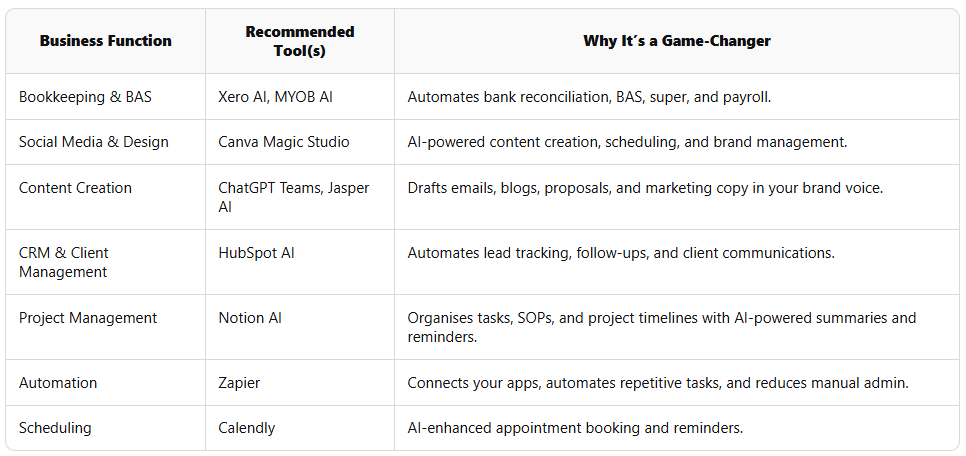
Essential Tools for the 2026 Solo Operator
Pro Tip:
Most of these tools offer affordable monthly plans (often under $100 AUD/month), and many have free tiers or trials. Start with the area causing you the most pain—bookkeeping, content, or client management—and build your stack from there.
How I Use These Tools in My Own Business
Let me share a typical workflow:
Bookkeeping: Xero AI reconciles my bank transactions, predicts invoice categories, and reminds me of BAS deadlines. I spend less than an hour a week on finances.
Content Creation: I batch-write social posts and newsletters using ChatGPT Teams and Jasper AI, then schedule them in Canva Magic Studio.
Client Management: HubSpot AI tracks leads, automates follow-ups, and even drafts client emails.
Project Management: Notion AI keeps my SOPs, checklists, and project plans in one place, with AI-generated summaries after every client meeting.
Automation: Zapier connects everything—when a client books via Calendly, they’re automatically added to my CRM and sent a welcome email.
Key Takeaway:
With the right digital toolkit, you can run a lean, professional business that punches well above its weight—no team required.
Productivity Strategies for the Solo Boss
Batch Working
Batch working means grouping similar tasks together—think writing all your social posts for the week in one sitting, or handling all invoicing on Friday afternoons. This reduces context switching and boosts focus.
Time-Blocking
Time-blocking is about scheduling specific periods for deep work, admin, and breaks. Tools like Google Calendar (with Gemini AI) or Notion AI can help you plan and stick to your blocks.
Example:
Mondays: Content creation
Tuesdays: Client calls
Wednesdays: Admin and finances
Thursdays: Marketing and outreach
Fridays: Learning and strategy
Government Support: You’re Not Alone
The Australian government recognises the power of women in business. Here are some key programs you should know about:
Boosting Female Founders Initiative: Grants between $25,000 and $480,000 for women-led startups to scale.
Women’s Enterprise Initiative: Grants up to $50,000 for eligible businesses.
Business.gov.au Grants Finder: Over 597 active programs as of 2026, including state-based grants for innovation, digital adoption, and more.
Pro Tip:
Many grants require co-funding and detailed reporting, but free business advisory services are available to help you apply and manage compliance.
Community and Mentorship: Find Your Tribe
Running solo doesn’t mean going it alone. Tap into these resources:
Angela Henderson: Business coach and podcast host, specialising in helping women build profitable solo businesses.
Entrepreneurial & Small Business Women Australia (ESBWA): The only independent organisation advocating for entrepreneurial and small business women across Australia.
Podcasts: “Business Women Australia” and “Women in the Business Arena” offer practical advice and community.
Part 2: Choosing to Run Solo—The Power of Autonomy
Why Some Women Choose the Solo Path
For many, running solo isn’t just a necessity—it’s a conscious, empowering choice.
Here’s why:
Autonomy: You call the shots. No staff to manage, no office politics, no compromise on your vision.
Flexibility: Work when and where you want. Need to pick up the kids or take a mental health day? You can.
Profitability: With low overheads, more of your revenue stays in your pocket.
Focus: You can build a business that aligns with your values, lifestyle, and goals.
Key Finding:
Female business owners report high levels of life satisfaction and value the flexibility of self-employment, with 47% working from home.
The Digital Soloist: Scaling Without a Team
Thanks to AI and automation, solo business owners can now achieve what once required a small army.
Here’s how:
1. AI as Your Digital Team
Bookkeeper: Xero AI or MYOB handles your finances.
Marketing Assistant: Canva Magic Studio and Jasper AI create and schedule your content.
Admin: Zapier automates your workflows.
Customer Service: AI chatbots (like Intercom Fin or Zendesk AI) answer routine queries 24/7.
2. Project Management and SOPs
Notion AI lets you document your processes, track projects, and even generate meeting summaries—so you never miss a beat.
3. Client Experience
HubSpot AI ensures every client feels valued, with automated follow-ups, reminders, and personalised communications.
The Joys (and Challenges) of Solo Business
The Upsides
Freedom: Design your business around your life, not the other way around.
Agility: Pivot quickly, test new ideas, and respond to market changes without bureaucracy.
Personal Growth: Every challenge is an opportunity to learn and grow.
The Downsides
Loneliness: It can get lonely at the top (and the bottom, and everywhere in between).
Responsibility: The buck stops with you—every decision, every mistake, every win.
Capacity Limits: There are only so many hours in the day, and burnout is a real risk.
Tip:
Combat isolation by joining online communities, attending local meetups, and investing in mentorship.
Practical Tips: Thriving as a Solo Business Owner in 2026
1. Start with One High-Impact Tool
Don’t try to overhaul everything at once. Identify your biggest pain point—maybe it’s bookkeeping, content creation, or client management—and implement a tool that solves it.
2. Build a Lean Tech Stack
Most successful solo businesses use 2–4 core tools that integrate seamlessly. Prioritise platforms with strong local support and compliance (think Xero, Canva, ChatGPT Teams).
3. Map Your Workflow
Choose tools that fit your existing processes. Avoid creating extra admin by forcing yourself into a system that doesn’t suit your style.
4. Trial and Measure
Use free tiers or trial periods, set clear success criteria, and track adoption before committing.
5. Prioritise Integration
Select tools that connect easily—Zapier is your friend here.
6. Batch and Block
Batch similar tasks and block out time for deep work. Protect your focus like it’s your most valuable asset—because it is.
7. Tap Into Support
Apply for grants, use free advisory services, and join communities like ESBWA. Don’t be afraid to ask for help.
Inspiration: Stories from the Solo Frontlines
Melanie Perkins (Canva): Built a global business by leveraging technology and empowering women entrepreneurs.
Julie Mathers (Flora & Fauna): Grew a solo-founded business into a market leader through digital-first strategies and automation.
Angela Henderson: Helps women build profitable, flexible solo businesses that prioritise time, freedom, and happiness.
Key Takeaway:
You’re not just running a business—you’re blazing a trail for the next generation of women entrepreneurs.

The Future Is Solo—and It’s Bright
The solo business model is here to stay. Whether you’re running solo out of necessity or by choice, you’re part of a movement that’s redefining what success looks like for women in business.
With the right tools, strategies, and support, you can build a business that’s profitable, sustainable, and deeply fulfilling. You don’t need a team to make a difference—you just need vision, grit, and a willingness to embrace the digital age.
Call to Action: Your Solo Journey Starts Now
So, what’s your next step? Maybe it’s trialling Xero AI for your bookkeeping, joining a community like ESBWA, or simply blocking out an hour this week to plan your next move.
Remember: You are capable. You are resourceful. And you are not alone.
Here’s to thriving—solo, but never isolated.
Summary Box:
61% of Australian small businesses are solo-run.
AI and automation make it possible to manage every aspect of your business without a team.
Government grants and community support are available—use them!
Batch working, time-blocking, and a lean tech stack are your secret weapons.
Whether by necessity or choice, solo business is a powerful, sustainable path for Australian women in 2026.
Ready to take your solo business to the next level? Reach out, join a community, or try a new tool today. The future is yours step at a time.
There are many ways of working with professionals. Start small, but keep it regularly and don’t wait until something happens. Strategic planning and periodic reviews are a great start to implement those strategies.
Perfectly Organised NT can assist with a financial review and strategic business planning & management. Find out more!

Perfectly Organised NT - helping small business owners in Australia manage their business.