Disclaimer: This blog post is intended for informational purposes only and does not constitute legal, financial, visa, or medical advice. Please consult with a qualified professional for advice tailored to your specific situation.
Before you click “subscribe” on that shiny new business tool, pause and ask yourself five critical questions. The right software can be a game-changer, but the wrong one quietly drains your cash flow, time, and mental energy. Let’s make sure every subscription truly earns its place in your business.

Introduction: The Midnight Subscription Trap
Picture this: It’s late. You’re sitting at your kitchen table, laptop open, half a cup of cold tea beside you. You’re scrolling through your inbox, and there it is—a glossy ad for the latest “must-have” business tool.
“Save 10 hours a week!” it promises.
“Automate your admin! Never chase an invoice again!”
You’re tired, you’re busy, and honestly, it sounds like exactly what you need. So you click “Buy Now.” Another $19.99 a month. What’s one more subscription?
Fast forward three months. That tool? You barely remember your login. The emails pile up, the invoices still take too long, and your bank statement is a graveyard of small, recurring charges. Welcome to the world of subscription creep—the slow, sneaky accumulation of software subscriptions that quietly siphon away your hard-earned cash.
If you’re a female small business owner or sole trader in Australia, I get it. We’re bombarded with tools that promise to fix everything—our time management, our marketing, our sanity. But here’s the thing: most business problems aren’t solved by buying more software. They’re solved by getting clear on what’s actually broken, and making intentional, strategic decisions.
So before you buy another subscription, let’s have a frank chat. Here are the five questions I ask myself—and every client—before adding anything new to our tech stack. Trust me, your future self (and your bank account) will thank you.
Why This Matters: The Real Cost of Subscription Creep
Let’s be honest: running a small business in Australia isn’t for the faint-hearted. We juggle everything—sales, admin, marketing, compliance—often with little more than a laptop and a lot of grit. And in this digital age, the lure of software is everywhere. But the true cost of subscriptions goes far beyond the $19.99 or $29.99 a month you see on your invoice.
The Hidden Costs
Training Time: Every new tool comes with a learning curve. That’s hours you’re not spending on billable work or growing your business.
Mental Load: Another login, another dashboard, another set of notifications. It all adds up.
Onboarding and Integration: Migrating data, setting up automations, connecting to your existing systems—it’s rarely as “plug and play” as the marketing suggests.
Unused Features: Most of us use a fraction of what we pay for. That fancy project management tool? You’re probably just using the to-do list.
Zombie Subscriptions: Tools that auto-renew, quietly charging your card while you forget they even exist.
The Emotional Pull
There’s also the “shiny object syndrome.” In the online business world, it’s easy to believe that the next tool will finally make things click. But as a solopreneur or small team, we don’t have an IT department to audit our tools or spare hours to learn new systems. Every subscription is a bet with your time and money.
So, how do we break the cycle? By asking better questions—before we buy.
Question One: What Specific Problem Am I Actually Trying to Solve—And Is It Really a Technology Problem?
Let’s start with the most important question. What’s the actual problem you’re facing? And is software really the answer?
Most Problems Are Process Problems
Here’s a truth bomb: most business headaches aren’t caused by a lack of software. They’re caused by unclear processes, inconsistent habits, or underused tools you already have.
Example:
If your invoicing is taking too long, is it because you don’t have invoicing software? Or is it because you haven’t set up a template, a payment schedule, and a routine for sending invoices every Friday? Maybe you’re not following up on overdue payments because you don’t have a simple checklist.
Expert Insight:
CPA Australia advises businesses to map out current workflows and identify pain points before considering new tools. Harvard Business Review echoes this: “What specific problem are we trying to solve? Is this a technology problem or a process problem?”
Map Your Workflow First
Before you reach for your credit card, grab a notebook. Sketch out the steps of the process that’s causing you grief. Where does it break down? Is there a manual step that could be streamlined? Are you duplicating work? Sometimes, a tweak to your routine or a better template is all you need.
Ask Yourself:
What’s the real bottleneck here?
Have I tried improving my current process?
Is there a feature in my existing tools that could help?
Takeaway:
Don’t let software become a band-aid for a process that needs surgery. Get clear on the problem first—then decide if technology is the right fix.
Have you checked out all the new tools, guides and checklists in our Resource Hub? Explore and download now!
Question Two: Am I Actually Using What I Already Have?
Here’s a confession: I’ve paid for software for months—sometimes years—without using half its features. Sound familiar?
The Underused Tool Trap
Most business owners are sitting on a goldmine of underused features. That project management tool you pay for? It probably has time-tracking, file storage, and automation built in. Your accounting software might offer a client portal, recurring invoices, or even basic CRM functions. Your email platform could automate follow-ups or segment your list—if you ever clicked beyond the “send” button.
Industry Wisdom:
Experts recommend auditing your current software for underused features before purchasing anything new. Schedule a periodic review of all subscriptions to identify unused or redundant tools.
The 20-Minute Software Audit
Set a timer for 20 minutes. Make a list of every tool you pay for, what it costs, and how often you use it. Be brutally honest. If you haven’t logged in for a month, it’s probably not essential.
Questions to Guide Your Audit:
What features am I actually using?
Are there overlapping tools doing the same job?
Could I consolidate or downgrade my subscriptions?
Example:
You’re paying for a separate scheduling tool, but your email platform includes a booking feature. Or you have three different note-taking apps, but only use one regularly.
Takeaway:
Before you buy, make sure you’re squeezing every drop of value from what you already have. Sometimes, the best tool is the one you already own.
Question Three: What Is the REAL Cost of This Subscription?
It’s easy to focus on the sticker price—$29 a month doesn’t sound like much. But the true cost of software goes much deeper.
Total Cost of Ownership (TCO)
Let’s break it down:
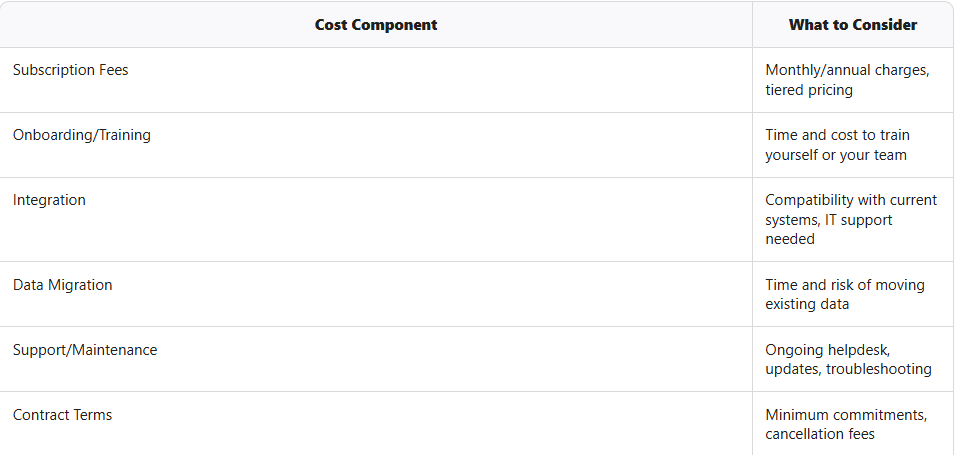
Worked Example:
That $29/month tool costs you $348/year in fees alone. But if it takes you five hours to set up—and you value your time at $80/hour—that’s another $400 before you’ve even sent a single invoice through it. Add in the mental load of managing another login, learning a new interface, and keeping up with updates, and the cost keeps climbing.
Expert Framework:
CPA Australia and other business advisors recommend calculating the total cost of ownership, not just the subscription fee. Include onboarding, integration, and the opportunity cost of your time.
The Hidden Costs
Time: Every hour spent learning a new tool is an hour not spent serving clients or growing your business.
Complexity: More tools mean more things to manage, more passwords to remember, and more potential for things to break.
Contract Traps: Some tools lock you into annual contracts or make it hard to cancel. Always read the fine print.
Takeaway:
Before you buy, add up the real cost—not just the dollars, but the hours and the headspace. Make sure the benefits truly outweigh the investment.
Question Four: Could a Simpler Solution—Or a Human—Solve This Better?
We live in a world that worships technology. But sometimes, the best solution isn’t another app—it’s a better process, a spreadsheet, or a real human being.
The Power of Simplicity
Lean operations experts emphasise improving workflows and eliminating waste before adding technology. Ask yourself: could a simple spreadsheet do the job? Could you tweak your process to remove a bottleneck? Sometimes, the answer is as simple as a checklist on your phone.
Example:
Instead of buying a fancy CRM, could you track leads in a Google Sheet? Instead of automating every email, could you set aside 15 minutes each morning to send personal follow-ups?
When Human Help Beats Software
There are times when a virtual assistant, bookkeeper, or online business manager is more flexible and cost-effective than software. Humans can adapt, problem-solve, and offer personalised support in ways that tools can’t.
Emotional Truth:
Sometimes, we reach for software because it feels safer than asking for help. Buying a tool feels like progress—no vulnerability required. But don’t underestimate the value of human support.
Questions to Consider:
Could a VA or OBM handle this task more efficiently?
Is there a manual workaround that’s just as effective?
Am I buying software to avoid asking for help?
Takeaway:
Don’t default to tech. Sometimes, the simplest solution—or a helping hand—is the smartest investment.
Question Five: If I Buy This, Do I Have a Plan for Reviewing Whether It’s Actually Working?
Most software purchases start with a burst of enthusiasm and end in neglect. Six weeks later, you’ve forgotten why you bought it in the first place.
The 30/60/90-Day Review
Set an intention before you buy: what does success look like? How will you know if this tool is delivering value? Schedule check-ins at 30, 60, and 90 days.
30 Days: Am I using this tool regularly? Is it making my life easier?
60 Days: Have I integrated it into my workflow? Are there features I’m not using?
90 Days: Is it delivering the promised benefits? If not, am I willing to cancel?
Expert Practice:
Regular software audits are essential. Inventory all subscriptions quarterly, assess usage, evaluate redundancy, and note cancellation deadlines. Normalise cancelling—it’s not failure, it’s smart business.
The Audit Checklist

Takeaway:
Every subscription should earn its keep. If it’s not delivering, let it go. Your business deserves tools that work as hard as you do.
Bringing It Together: The 15-Minute Subscription Audit
Ready for some practical action? Here’s a quick exercise you can do right now.
The 15-Minute Subscription Audit
1) List Every Tool:
Write down every software subscription you’re currently paying for.
2) Note the Monthly Cost:
Add up the total. (Prepare for a surprise!)
3) Ask Yourself:
Do I use this weekly?
Does this solve a problem I couldn’t solve any other way?
Could I cancel this today without my business suffering?
4) Highlight Candidates for Cancellation:
If a tool isn’t essential, put a star next to it. Set a reminder to review or cancel before the next billing cycle.
Pro Tip:
Do this audit every quarter. Your future self will thank you.

Conclusion: Be a Strategic Owner, Not a Subscription Collector
Let’s wrap this up with some real talk. I’m not anti-technology. I love a good tool as much as anyone. But I’ve learned—sometimes the hard way—that more software doesn’t equal a better business. The best tools are the ones that genuinely solve a real problem, get used consistently, and deliver a clear return on investment.
As female business owners and sole traders in Australia, we have enough on our plates. Let’s be intentional. Let’s make every subscription earn its place. Let’s think like strategic business owners, not consumers chasing the next shiny thing.
Key Finding:
Every dollar and every hour counts. Make your software work for you—not the other way around.
There are many ways of working with professionals. Start small, but keep it regularly and don’t wait until something happens. Strategic planning and periodic reviews are a great start to implement those strategies.
Perfectly Organised NT can assist with a financial review and strategic business planning & management. Find out more!

Perfectly Organised NT - helping small business owners in Australia manage their business.