Offshoring – Something to Consider as a Small Business Owner in Australia?
Disclaimer: This blog post is intended for informational purposes only and does not constitute legal, financial, visa, or medical advice. Please consult with a qualified professional for advice tailored to your specific situation.
Offshoring is no longer just for big corporations. In 2026, it’s a powerful, accessible strategy for Australian female small business owners to save costs, access global talent, and reclaim precious time—while navigating real risks with confidence and care.

Table of Contents
1) Introduction: Offshoring—A New Normal for Small Business Owners
2) Offshoring in Australia: The 2026 Landscape
3) Why Offshoring? The Compelling Benefits for Small Businesses
Cost Savings: The Numbers Speak for Themselves
Access to Global Talent
Scalability and Flexibility
Reclaiming Your Time
24/7 Operations and Faster Turnaround
4) The Real Risks and How to Manage Them
Communication Barriers
Quality Control
Data Security and Privacy
Cultural Differences
Intellectual Property Risks
Managing Across Time Zones
5) Where to Offshore? Top Destinations for Australian SMEs
6) What Roles Are Best Offshored? Cost Comparisons
7) How to Offshore: Trusted Platforms and Agencies
8) Legal, Tax, and Compliance Essentials for 2026
9) Getting Started: A Practical Step-by-Step Guide
10) Conclusion: Offshoring as a Tool for Growth, Freedom, and Sustainability
1. Introduction: Offshoring—A New Normal for Small Business Owners
Hello, fellow business owner!
If you’re reading this, you’re probably juggling a million things—clients, cash flow, compliance, and maybe even school pick-ups. As a woman running a small business in Australia, I know firsthand how much we carry. That’s why I want to talk openly about a topic that’s often misunderstood, sometimes whispered about, but increasingly embraced: offshoring.
Let’s be clear: offshoring isn’t just for the big end of town anymore. In 2026, it’s a mainstream, strategic tool for small businesses—especially for women who want to grow, reclaim their time, and build sustainable, resilient companies. If you’ve ever wondered whether offshoring could work for you, this post is for you. I’ll share the latest trends, real numbers, practical advice, and the honest pros and cons—so you can make an empowered, informed decision.
2. Offshoring in Australia: The 2026 Landscape
Let’s start with the facts. Offshoring is booming among Australian small businesses:
30,000+ Australian businesses are already offshoring some part of their operations.
The offshoring industry is worth $35 billion and is growing at 3.3% annually.
The broader Business Process Outsourcing (BPO) market in Australia hit $49.6 billion in 2025, with growth accelerating in 2026.
This isn’t just a big business trend—SMEs are leading the charge, driven by:
Skills shortages (Australia’s talent pool is stretched thin)
Cost pressures (wages and overheads keep rising)
Technology (remote work tools make global teams seamless)
Key Finding:
Offshoring is now a mainstream, strategic solution for Australian small businesses—especially as we face ongoing skills shortages and rising costs.
3. Why Offshoring? The Compelling Benefits for Small Businesses
Let’s break down the real, tangible benefits of offshoring for small business owners like us.
Cost Savings: The Numbers Speak for Themselves
The most obvious—and often most compelling—reason to consider offshoring is cost savings.
Here’s what the numbers look like in 2026:

Example:
A Brisbane SaaS startup saved $336,000 annually by offshoring development. A Sydney logistics platform shipped features faster and cheaper with a hybrid onshore-offshore model.
Why so much cheaper?
Lower wage costs in countries like the Philippines, India, and Vietnam
Offshore agencies often cover equipment, HR, and office space
No superannuation, payroll tax, or WorkCover for offshore contractors
Access to Global Talent
Australia’s skills shortage is real—79% of employers struggle to find suitably skilled candidates.
Offshoring opens the door to a global talent pool:
IT & Tech: Australia needs 312,000 more tech workers by 2030, but only 7,000 IT grads a year.
Admin, Finance, Creative: The Philippines and India offer millions of English-speaking, degree-qualified professionals.
Specialised Skills: From AI engineers to Xero-certified bookkeepers, you can find the expertise you need—fast.
Scalability and Flexibility
Rapid hiring: Build a team of 5 offshore in 4–6 weeks (vs. 3–6 months locally).
Scale up or down: Flex your team for launches, busy seasons, or special projects—without long-term commitments or office space headaches.
Variable costs: Pay only for what you need, when you need it.
Reclaiming Your Time
Delegate routine tasks: Free up 20–30% of your executive time by offshoring admin, bookkeeping, and customer support.
Focus on growth: Spend more time on strategy, innovation, and the parts of your business you love.
24/7 Operations and Faster Turnaround
Time zone advantage: The Philippines is just 2–3 hours behind AEST, making real-time collaboration easy.
Round-the-clock productivity: Offshore teams can keep your business moving while you sleep—speeding up projects and customer response times.
Have you checked out all the new tools, guides and checklists in our Resource Hub? Explore and download now!
4. The Real Risks and How to Manage Them
Offshoring isn’t a magic bullet. There are real risks and challenges—but with the right strategies, they’re manageable.
Communication Barriers
Language: While the Philippines and India have strong English skills, accents and idioms can cause misunderstandings.
Time zones: Even a 2–3 hour difference can complicate meetings and deadlines.
Mitigation:
Choose destinations with high English proficiency (like the Philippines).
Use clear, written instructions and regular video calls.
Set overlapping work hours for real-time collaboration.
Quality Control
Consistency: Quality can slip if expectations aren’t clear or oversight is lacking.
Role suitability: Process-driven roles (admin, bookkeeping) are lower risk; creative or highly regulated roles need closer management.
Mitigation:
Set clear KPIs and deliverables.
Use regular work reviews and feedback loops.
Appoint a local manager or team lead to oversee offshore staff.
Data Security and Privacy
Australian Privacy Act 1988: You’re responsible for protecting customer data—even if it’s handled offshore.
Risks: Data breaches, mishandling of sensitive information.
Mitigation:
Use secure systems and limit data access.
Have offshore staff sign confidentiality agreements.
Choose agencies with strong data security protocols.
Ensure contracts require compliance with Australian privacy standards.
Cultural Differences
Workplace norms: Hierarchy, feedback styles, and holidays can differ.
Integration: Building team culture across borders takes effort.
Mitigation:
Invest in onboarding and cross-cultural training.
Celebrate wins and milestones together.
Foster open communication and feedback.
Intellectual Property Risks
IP theft or misuse: If contracts aren’t clear, you could lose control of your IP.
Mitigation:
Use contracts with IP assignment clauses governed by Australian law.
Require NDAs and use company-owned devices for sensitive work.
Seek legal advice for cross-border agreements.
Managing Across Time Zones
Supervision: Remote teams need new processes for onboarding, performance tracking, and engagement.
Mitigation:
Hold daily standups and regular check-ins.
Use project management tools (e.g., Asana, Trello).
Visit offshore teams in person if possible.
5. Where to Offshore? Top Destinations for Australian SMEs
Not all offshoring destinations are created equal.
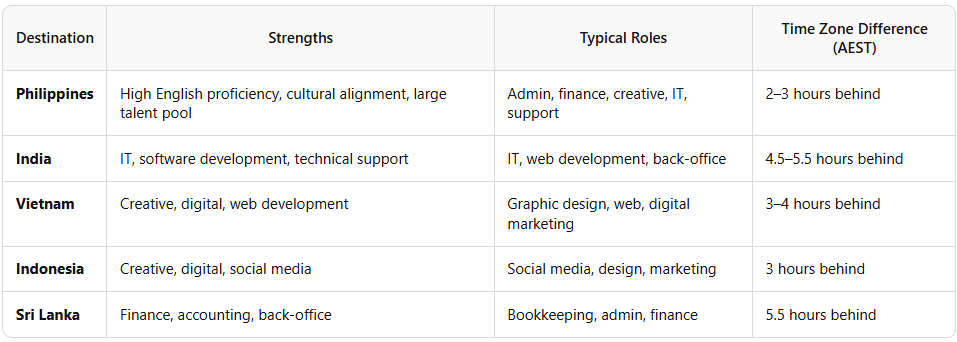
Here’s where Australian small businesses are finding the best results in 2026:
Key Finding:
The Philippines is the top recommendation for Australian SMEs—especially for admin, finance, customer service, and creative roles—thanks to English skills, cultural fit, and time zone compatibility.
6. What Roles Are Best Offshored? Cost Comparisons
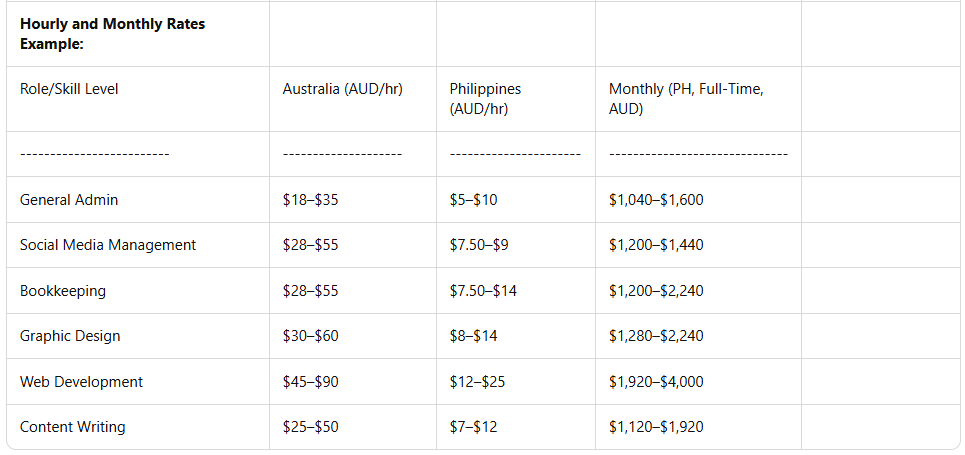
Here’s where offshoring really shines for small businesses. The most commonly offshored roles—and the savings—are substantial:

Case Study:
A Sydney-based business offshored bookkeeping to the Philippines, saving $76,368 in the first year and nearly $70,000 per year ongoing.
7. How to Offshore: Trusted Platforms and Agencies
You don’t have to go it alone. Here are the most popular, reputable platforms and agencies Australian SMEs are using in 2026:

Tip:
Managed agencies handle recruitment, HR, payroll, and compliance—making offshoring accessible and lower risk for small businesses. Direct hiring (e.g., Onlinejobs.ph) is cheaper but requires more hands-on management.
8. Legal, Tax, and Compliance Essentials for 2026
Offshoring is powerful—but you must get the legal and compliance side right.
Here’s what you need to know in 2026:
Worker Classification: Employee vs. Contractor
ATO rules: Correctly classify offshore workers as employees or contractors. Misclassification can mean penalties.
Employees: PAYG withholding, superannuation, and Fair Work Act may apply.
Contractors: No PAYG unless no ABN; super may still apply if the contract is mainly for labour.
PAYG Withholding
Employees: Must withhold PAYG tax and report to the ATO.
Contractors: Withhold only if no ABN or by voluntary agreement.
Superannuation: Payday Super from 1 July 2026
New rule: Super must be paid on every payday, not quarterly.
Contractors: If the contract is mainly for labour, you may need to pay super—even if they have an ABN.
Fair Work Act Applicability
Applies to Australian-based employees, including those working overseas for an Australian employer.
Overseas contractors are generally not covered, but check specifics.
Data Privacy: Australian Privacy Act 1988
You’re responsible for customer data, even if handled offshore.
Use contracts and data processing agreements to ensure compliance.
Limit access to sensitive data and use secure systems.
Intellectual Property (IP) Protection
Use contracts with clear IP assignment clauses.
Specify Australian law as the governing law.
NDAs and secure devices are a must.
Seek Professional Advice
Consult legal and tax professionals experienced in cross-border employment and contracting.
Stay updated on ATO and Fair Work changes.
9. Getting Started: A Practical Step-by-Step Guide
Ready to explore offshoring?
Here’s how to start—safely and strategically:
1) Assess Your Needs
Identify which roles or tasks are suitable for offshoring (admin, bookkeeping, customer service, etc.).
Start with non-core, process-driven roles for the lowest risk.
2) Start Small
Begin with one role or a small team.
Test the waters before scaling up.
3) Choose the Right Platform or Agency
Decide between managed agency (less risk, more support) or direct hire (lower cost, more management).
Research agencies’ track records, data security, and support.
4) Draft Robust Contracts
Clearly define deliverables, payment terms, confidentiality, IP ownership, and dispute resolution.
Use Australian law as the governing law where possible.
5) Set Clear KPIs and Communication Protocols
Define what success looks like.
Schedule regular check-ins and feedback sessions.
6) Invest in Onboarding and Training
Treat offshore staff as part of your team.
Provide training, resources, and cultural integration.
7) Monitor Compliance and Stay Informed
Keep up with ATO, Fair Work, and privacy law changes.
Seek professional advice as needed.
Pro Tip:
A hybrid model—offshore execution with local leadership—often delivers the best balance of cost, quality, and control.

10. Conclusion: Offshoring as a Tool for Growth, Freedom, and Sustainability
As Australian female small business owners, we’re used to wearing many hats. Offshoring isn’t about “sending jobs overseas”—it’s about building a business that’s sustainable, scalable, and gives you the freedom to focus on what matters most.
In 2026, offshoring is a legitimate, proven strategy for small businesses—not just the big players. With the right approach, you can save 60–80% on staffing, access global talent, and reclaim your time—while managing risks with confidence.
Empowering Call to Action:
If you’re ready to explore offshoring as a growth strategy, or if you want help navigating the legal, tax, and compliance landscape, I’m here to help. My business management service specialises in supporting Australian women just like you—helping you plan strategically, grow sustainably, and build a business (and life) you love.
Summary Box:
Offshoring is mainstream for Australian SMEs in 2026—30,000+ businesses are already doing it.
Save 60–80% on staffing, access global talent, and scale flexibly.
Real risks exist—communication, quality, data security, compliance—but can be managed with the right strategies.
The Philippines is the top destination for most roles; India and Vietnam are strong for IT and creative work.
Start small, use trusted agencies, draft robust contracts, and seek professional advice.
Offshoring can be your pathway to growth, freedom, and a more sustainable business.
There are many ways of working with professionals. Start small, but keep it regularly and don’t wait until something happens. Strategic planning and periodic reviews are a great start to implement those strategies.
Perfectly Organised NT can assist with a financial review and strategic business planning & management. Find out more!

Perfectly Organised NT - helping small business owners in Australia manage their business.