Don’t Automate a Mess: What to Fix Before You Add AI
Disclaimer: This blog post is intended for informational purposes only and does not constitute legal, financial, visa, or medical advice. Please consult with a qualified professional for advice tailored to your specific situation.
Before you jump on the AI bandwagon, make sure your business foundations—your processes, your data, your compliance, and your team—are rock solid. Automating a mess just creates a faster, more expensive mess.

Introduction: The AI Hype Is Real—But So Are the Pitfalls
If you’re a female small business owner in Australia in 2026, you’ve probably felt the pressure to “get on board with AI.” Maybe you’ve seen headlines about businesses growing 2.8 times faster with AI, or you’ve heard that 40% of Aussie SMEs are already using AI tools in their day-to-day operations. Your inbox is full of webinars, your software vendors are pushing new “AI-powered” features, and your competitors are boasting about their latest automations.
But here’s the truth:
AI is not a magic wand.
If your business processes are messy, your data is patchy, or your compliance is shaky, adding AI will only amplify those problems. As the saying goes, “Don’t automate a mess.” I’ve seen too many businesses—especially women-led ones—waste time, money, and energy chasing shiny tech before fixing what really matters.
In this post, I’ll walk you through what youmustfix before you add AI, drawing on real Australian examples, the latest stats, and practical frameworks I use with my own clients. Whether you’re a sole trader in health, running a small e-commerce store, or juggling a team in professional services, this guide is for you.
Why the Rush? The 2026 AI Adoption Landscape in Australia
Let’s ground this conversation in the current reality:
40% of Australian SMEs are now using AI products and features (MYOB Business Monitor, April 2026).
AI-powered businesses are growing 2.8 times faster than those that aren’t.
12% of all Australian businesses (and 11% of small/micro businesses) reported using AI in 2024–25 (ABS).
In sectors like information, media, and professional services, AI adoption is even higher—up to 38%.
But here’s the kicker:
46% of SMEs say they’re not using AI and have no plans to do so in the next 12 months.
There’s a real divide between the “AI haves” and “have-nots”—and a lot of that comes down to readiness, not just willingness.
The Cost of Automating Too Soon: Real-World Lessons
Let’s get real. AI can be a game-changer, but only if your business is ready.
Here are some cautionary tales and success stories from right here in Australia:
When Automation Goes Wrong
MIT found that 95% of enterprise AI pilots failed to deliver measurable return—almost always because teams tried to automate before fixing their processes or cleaning their data. They bought the tool first, then tried to make it fit. The result? More chaos, not less.
CRM Migration Fails: I’ve seen businesses migrate to a shiny new CRM without cleaning up their old data. The result? Duplicates everywhere, outdated contacts, broken workflows—and more manual work than before.
When Fixing First Pays Off
Finance Broker Reactivation: One client, a finance broker, recovered $49,000 from 319 dormant contacts—but only after cleaning and enriching their CRM data before automating outreach. If they’d automated with messy data, they’d have wasted time and risked breaching privacy laws.
Dental Practice Call Automation: A dental practice reduced unanswered calls from 47% to zero and increased booked appointments by 44%—but only after mapping their call-handling process, cleaning up their contact database, and then automating. The process and data fix came first; AI was the cherry on top.
Key Finding:
Automating a broken process or messy data just creates a faster, more expensive mess. Fix first, automate second.
Have you checked out all the new tools, guides and checklists in our Resource Hub? Explore and download now!
Four Strategic Fixes Before You Add AI
Let’s break down exactly what you need to fix before you even think about plugging in AI. These are the four pillars I use with every client—especially women-led businesses who are often juggling more with less.
Fix 1: Map and Document Your Processes
Why It Matters
AI thrives on clarity and consistency. If your workflows are undocumented, full of workarounds, or reliant on “that’s just how we do it,” AI will only amplify the confusion.
How to Do It
Inventory Your Processes: List every recurring workflow—lead intake, invoicing, order fulfillment, client onboarding, payroll, you name it.
Map Visually: Use tools like Miro, Lucidchart, or even a whiteboard to diagram how work actually flows. Capture every step, handoff, and tool involved.
Document SOPs: Write clear, step-by-step Standard Operating Procedures (SOPs) for each process. This protects your business if someone leaves and makes training easier.
Identify Bottlenecks: Look for steps where work piles up, approvals stall, or errors are common.
Tag for Automation: For each step, ask: Is this repetitive, rule-based, and high-volume? If yes, it’s a candidate for automation. If it requires judgment or is unstable, keep it manual for now.
Practical Example
A regional female-led health service mapped their client intake process and discovered three unnecessary handoffs and two manual data entry points. By streamlining and documenting the process, they cut admin time by 30%—beforeadding any automation.
Tools to Try
Miro or Lucidchart for mapping
Google Docs or Notion for SOPs
Zapier for simple automations (once you’re ready)
Fix 2: Clean Your Data
Why It Matters
AI is only as good as the data you feed it. “Garbage in, garbage out” is more true than ever. Messy, duplicate, or outdated data will lead to bad decisions, wasted effort, and even compliance breaches.
How to Do It
Audit Your CRM/Data: Identify missing fields, duplicates, stale records, and inconsistent values.
Remove/Merge Duplicates: Use your CRM’s deduplication tools or third-party apps like Insycle or Dedupely.
Standardise Naming Conventions: Make sure company names, phone numbers, and addresses follow a consistent format. Use dropdowns instead of free text where possible.
Validate at Entry: Set up required fields and format rules so new data is clean from the start.
Archive/Delete Stale Records: Remove contacts with no activity in 12+ months (after checking compliance requirements).
Assign a Data Steward: Someone (even if it’s you) needs to own ongoing data hygiene.
Practical Example
A female-led e-commerce business using Xero and Shopify found that 20% of their customer records were duplicates. After a thorough cleanup and standardisation, their marketing automations became twice as effective—and they avoided sending duplicate emails (a compliance risk under the new Privacy Act).
Tools to Try
Xero (47–60% market share among Aussie SMEs) and MYOB (20–25%) both have built-in data tools.
Hubdoc and Dext for document capture and data extraction.
Zapier for automating data entry (once your data is clean).
Fix 3: Build Your Compliance and Governance Foundation
Why It Matters
The rules have changed. As of December 2026, the small business exemption from the Privacy Act is gone. That means almost every small business in Australia—yes, even sole traders—must comply with strict privacy, consent, and AI transparency rules. Penalties for serious breaches are now up to $50 million.
What You Need to Know
Privacy Act Reforms (2024–2026): Stronger enforcement, higher penalties, and new rights for individuals.
Automated Decision-Making (ADM) Transparency: From 10 December 2026, you must disclose in your privacy policy if you use AI or computer programs to make decisions that affect people’s rights or interests.
Consent Requirements: Consent must be voluntary, informed, current, specific, and unambiguous. No more pre-ticked boxes or bundled consents.
Right to Explanation and Human Review: If someone is affected by an automated decision, they have the right to an explanation and a meaningful human review.
Data Quality and Security: You must ensure personal information is accurate, up-to-date, and protected by both technical and organisational measures.
Privacy Impact Assessments (PIAs): Strongly recommended (and often required) before deploying new AI systems.
Practical Example
A small consultancy with three staff used MYOB for payroll and Zapier for client onboarding. Before automating more, they updated their privacy policy, implemented a consent process for marketing, and conducted a PIA for their new AI-powered quoting tool. This not only kept them compliant but built trust with clients.
Tools and Resources
OAIC Guidance: The Office of the Australian Information Commissioner has practical guides for small businesses.
AI Policy Templates: Available from business.gov.au and industry associations.
Privacy Impact Assessment Checklists: Use these before launching any new AI-driven process.
Fix 4: Conduct an Honest AI Readiness Assessment
Why It Matters
AI success is 70% about people and process, not technology (BCG/McKinsey). Most Australian SMBs score just 40–60% on their first AI readiness assessment. That’s normal—but it means there’s work to do before you dive in.
The Six Dimensions of AI Readiness
Data Quality: Is your data accurate, complete, deduplicated, and accessible?
Process Maturity: Are your workflows documented, stable, and standardised?
Team Capability: Does your team understand and support AI adoption? Are they trained and ready for change?
Infrastructure: Are your systems integrated, secure, and API-ready?
Governance & Compliance: Do you have policies for privacy, risk, and responsible AI?
Strategic Alignment: Is there a clear business case and leadership support for AI?
How to Assess
Use a simple checklist (see below).
Be brutally honest—this isn’t about passing or failing, but about knowing where to focus.
Address the biggest gaps first.
Practical Example
A local service business (plumbing) used AI for intake and quoting only after mapping their intake process, cleaning up their customer list, and ensuring the owner still approved all quotes. They scored low on process maturity at first, but by focusing there, they set themselves up for successful automation.
Your Pre-AI Checklist: Are You Ready?
Before you invest in any AI tool, run through this checklist. If you can’t tick most of these, focus on fixing first.
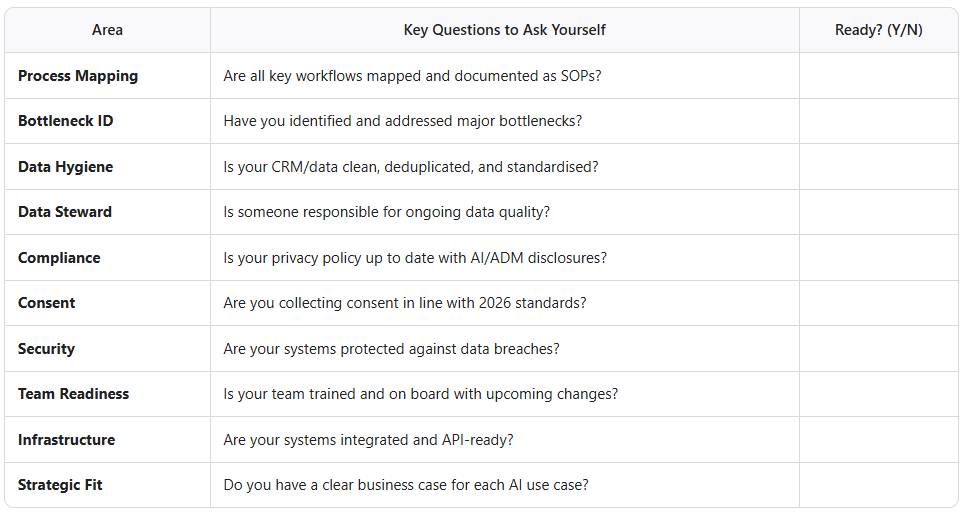
Locally Relevant Tools and Scenarios
Here’s what I see most often with my clients:
Xero: The go-to for accounting, with AI-powered bank reconciliation and analytics. Used by 47–60% of Aussie SMEs.
MYOB: Preferred for complex payroll or inventory, with strong automation features.
Hubdoc/Dext: For document capture and data extraction—great for reducing manual entry.
Zapier: For connecting apps and automating repetitive tasks (once your processes and data are ready).
Rounded: A favourite for sole traders and freelancers.
Shopify + Xero: Common for e-commerce businesses, but only works well if your product and customer data is clean and mapped.
Typical scenarios:
A female sole trader in health services using Xero and Hubdoc, juggling business and family, now facing new privacy compliance requirements.
A female-led e-commerce business using Shopify, Xero, and Dext, needing to update privacy policies for AI-driven product recommendations.
A small consultancy automating client onboarding with Zapier, but only after mapping the process and updating compliance.
The Unique Context for Female Business Owners
Let’s acknowledge the reality:
35% of all small businesses in Australia are women-owned—that’s over half a million of us.
40% of sole traders are women, especially in health, education, and services.
We’re often juggling dual responsibilities—business and family—and facing barriers like access to capital, unconscious bias, and limited networking opportunities.
Despite this, 70% of us say Australia is a good place to start a business. We’re optimistic, resilient, and ready to grow.
But we can’t afford to waste time or money on tech that doesn’t deliver. That’s why getting your foundations right is even more important.
What Happens If You Skip the Fixes?
Wasted Money: AI tools aren’t cheap. If you automate a broken process, you’ll spend more fixing the fallout.
Compliance Risks: With the new Privacy Act, mistakes can cost you up to $50 million. Ignorance is no longer an excuse.
Lost Trust: Customers are savvy. If your AI makes mistakes, sends duplicate emails, or mishandles data, your reputation takes a hit.
Team Frustration: If your team doesn’t understand or trust the new tools, adoption will stall—and morale will drop.
What Happens When You Get It Right?
Time Savings: 54% of SMEs report saving time after adopting AI—if their processes and data are ready.
Productivity Gains: 34% see improved productivity.
Profitability: 76% of small businesses using AI reported increased profitability last year.
Growth: AI-ready businesses are growing 2.8 times faster.
But all of this only happens when you fix the foundations first.
Your Next Steps: Action Plan
Block out time this month to map your key processes. Even one hour a week makes a difference.
Audit your data. Run a deduplication pass, standardise your naming conventions, and assign a data steward.
Review your compliance. Update your privacy policy, check your consent processes, and conduct a Privacy Impact Assessment if you’re planning new automations.
Run an AI readiness assessment. Be honest about your gaps and focus your efforts there.
Leverage local support. The Federal Government’s AI Adopt Centres offer free training, consultations, and resources for SMEs. Use them!

Conclusion: Fix First, Automate Second—And Thrive
AI is here to stay, and it can absolutely help your business grow—if you lay the right groundwork. As a fellow female business owner and advisor, I want you to succeed, not just survive. Don’t let the hype push you into automating chaos. Take the time to fix your processes, clean your data, get compliant, and build your team’s capability.
Remember:
“Don’t automate a mess.” Fix first, automate second, and you’ll set your business up for sustainable, scalable success.
Let’s make AI work for you—on your terms, and on a rock-solid foundation.
Ready to take your business knowledge to the next level? Book a strategy session with me, join our community of female founders.
There are many ways of working with professionals. Start small, but keep it regularly and don’t wait until something happens. Strategic planning and periodic reviews are a great start to implement those strategies.
Perfectly Organised NT can assist with a financial review and strategic business planning & management. Find out more!

Perfectly Organised NT - helping small business owners in Australia manage their business.