Diversifying as a Small Business Owner in Australia
Disclaimer: This blog post is intended for informational purposes only and does not constitute legal, financial, visa, or medical advice. Please consult with a qualified professional for advice tailored to your specific situation.
Diversification can be a powerful tool for Australian female small business owners to build resilience, unlock new revenue streams, and future-proof their businesses—but it comes with real risks. The key is to diversify strategically, test ideas safely, and never lose sight of your core strengths and values.

Introduction: The Changing Face of Australian Small Business
G’day, fellow business owners!
If you’re reading this, chances are you’re a woman running a small business in Australia—or you’re dreaming of starting one. You’re not alone. Did you know that as of 2024, one in three small businesses in Australia are run by women? That’s a massive leap from just a couple of decades ago, with female business ownership growing by 24% between 2006 and 2021—outpacing the blokes by more than three times.
But let’s be real:
It’s not all smooth sailing. A whopping 74% of female founders say inflation is their biggest challenge right now, and with two-thirds of Aussie businesses earning under $200,000 a year, every dollar and every hour counts,. In this climate, the idea of “diversifying” your business—adding new products, services, or revenue streams—can sound both exciting and terrifying.
As someone who’s spent years helping women like you manage, grow, and future-proof their businesses, I want to share what I’ve learned about diversification: the options, the upsides, the pitfalls, and—most importantly—how to do it safely.
Let’s dive in.
What Does Diversification Mean for Australian Small Business Owners?
At its core, diversification means expanding your business beyond its original product, service, or market. For us as small business owners, especially women juggling family, community, and business, it’s about building resilience and creating new opportunities—without losing what makes our businesses special.
Why Diversify?
Reduce risk: Don’t put all your eggs in one basket.
Unlock new income: Find fresh ways to make money.
Stay relevant: Adapt to changing markets and customer needs.
Leverage your strengths: Use your existing skills, assets, and networks in new ways.
But diversification isn’t just about “doing more.”
It’s about doing the right more.
Realistic Diversification Options for Australian Small Business Owners
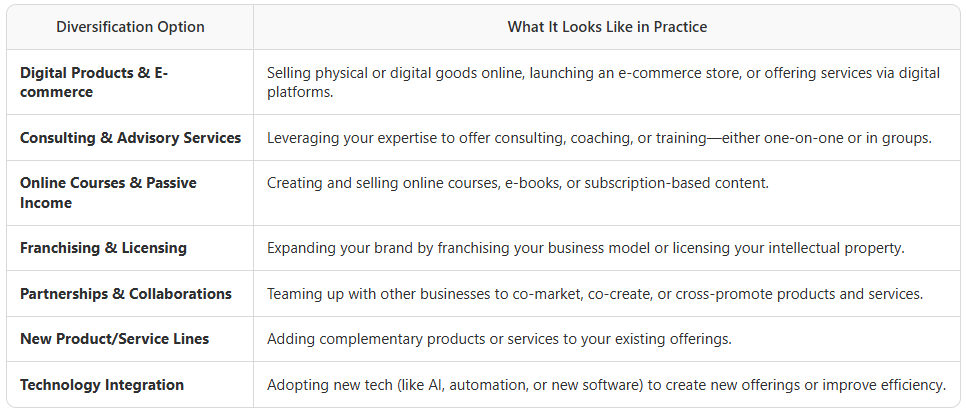
Let’s get practical. Here are some of the most popular and realistic ways Australian women are diversifying their businesses right now:
How Are Australian Women Embracing These Options?
Digital transformation is booming. More women are launching online stores, offering virtual services, and creating digital products than ever before.
Consulting and coaching are popular, especially for those with deep expertise in their field.
Online courses and passive income streams are on the rise, with many women turning their knowledge into scalable products.
Collaborations are especially strong among women in regional areas, who are pooling resources and networks to reach new markets.
Tech adoption is accelerating, with more women integrating automation and AI to streamline operations and offer new services.
Have you checked out all the new tools, guides and checklists in our Resource Hub? Explore and download now!
The Pros of Diversification: Why It’s Worth Considering
Let’s talk about the upside. When done well, diversification can be a game-changer for your business.
1. Revenue Resilience
Statistically, businesses that diversify are 87% less likely to file for bankruptcy. That’s a huge buffer against tough times.
Multiple income streams mean you’re not at the mercy of one product, client, or market.
2. Access to New Markets and Customers
Diversification lets you tap into new customer segments—whether that’s B2B, B2C, or even international markets.
It can open doors to partnerships, collaborations, and new distribution channels.
3. Leveraging Existing Skills and Assets
You can build on what you already know and own—your expertise, your brand, your customer base.
This makes diversification less risky and more manageable.
4. Innovation and Competitive Advantage
Diversifying encourages you to innovate, stay ahead of competitors, and adapt to changing trends.
It keeps your business dynamic and relevant.
5. Future-Proofing Against Market Volatility
With inflation, supply chain shocks, and changing consumer behaviour, having multiple revenue streams is a smart way to weather storms.
Key Finding:
Diversification isn’t just about growth—it’s about survival and sustainability in a rapidly changing world.
The Cons and Risks of Diversification: What You Need to Watch Out For
Now, let’s get honest about the risks. Diversification isn’t a magic bullet, and for small businesses—especially micro-businesses and sole traders (which make up 89% of all Aussie businesses)—the stakes are high.
1. Distraction from Your Core Business
Diversifying can pull your focus away from what you do best.
For solo operators, the extra workload can be overwhelming and lead to burnout.
2. Capital Outlay and Financial Risk
New ventures often require upfront investment—money for research, development, marketing, and operations.
If the new idea flops, the financial loss can be devastating, especially if your cash flow is tight.
3. Brand Dilution
Expanding into unrelated areas can confuse your customers and weaken your brand’s identity.
It’s easy to lose sight of what makes your business unique.
4. Operational Complexity
More products or services mean more systems, processes, and possibly staff.
This can strain your resources and make your business harder to manage.
5. Increased Failure Rates
60% of companies that diversify into slow-growth sectors fail.
In Australia, 60% of small businesses fail within three years—and failed diversification is a common culprit.
Key Finding:
The margin for error is slim. Diversification can be a double-edged sword—done poorly, it can sink your business.
The Real Cost of Failed Diversification: Time, Money, and Emotional Toll
Let’s talk about what happens when diversification goes wrong—because for small business owners, the cost isn’t just financial.
1. Lost Time
Time is your most precious resource. Every hour spent on a failed diversification is an hour you can’t get back.
For women juggling business, family, and community, this lost time can be especially painful.
2. Financial Strain
With two-thirds of Aussie businesses earning under $200,000 a year, even a modest failed investment can hurt.
The cost of a single employee can exceed $90,000 a year—imagine losing that on a failed venture.
3. Emotional Toll
Failed diversification can knock your confidence, sap your motivation, and create stress at home and work.
It can also damage relationships with customers, staff, and partners.
4. Endangering the Core Business
If you neglect your main business while chasing new ideas, you risk losing what you’ve built.
Many small businesses have failed not because their core offering was weak, but because they overextended themselves.
Key Takeaway:
The cost of failed diversification is real—and for small business owners, it can be the difference between thriving and closing your doors.
How to Pick a Diversification Idea and Test It Safely: A Step-by-Step Guide
So, how do you diversify without risking everything?
Here’s the practical, step-by-step approach I recommend to my clients:
Step 1: Identify the Opportunity
Start with your strengths. What skills, assets, or customer needs can you build on?
Look for gaps. What are your customers asking for that you don’t currently offer?
Research the market. Is there real demand for your idea?
Step 2: Validate the Problem
Talk to potential customers. Use interviews, surveys, or informal chats to test your assumptions.
Check the competition. Who else is offering this? What can you do differently or better?
Step 3: Test Your Assumptions (MVP/MVT)
Minimum Viable Product (MVP): Create the simplest version of your new product or service and offer it to real customers.
Minimum Viable Test (MVT): Test the riskiest part of your idea with minimal investment—like a landing page, a pre-sale, or a prototype.
Example: Before launching a full online course, offer a free webinar or a paid mini-workshop to gauge interest.
Step 4: Run a Pilot or Soft Launch
Pilot program: Offer your new product/service to a small group of trusted customers and gather feedback.
Soft launch: Release quietly to a limited audience, refine based on feedback, and only scale up if the results are promising.
Step 5: Analyse Results and Iterate
Gather feedback. What worked? What didn’t? What surprised you?
Be honest. If the demand isn’t there, don’t be afraid to pivot or pull the plug.
Step 6: Scale Gradually
Staged investment: Only commit more resources as evidence of demand grows.
Monitor your metrics: Track sales, customer feedback, and your own workload.
Step 7: Leverage Your Existing Customer Base
Test new offerings with your current customers. They already trust you and can provide valuable feedback.
Use your network. Collaborate with other women in business to share resources and insights.
Practical Example: Diversifying with an Online Course
Suppose you run a successful bookkeeping business and want to diversify by offering an online course for small business owners.
Identify the opportunity: Your clients often ask for basic bookkeeping tips.
Validate the problem: Survey your clients—do they want a course? What topics interest them?
Test your assumptions: Run a free webinar or a paid mini-workshop.
Pilot: Offer the course to a small group at a discount in exchange for feedback.
Analyse: Did people sign up? Did they finish the course? What feedback did you get?
Iterate: Refine the course based on feedback.
Scale: Launch to your full client base and promote through your network.
My Thoughts, Ideas, and Suggestions
As someone who’s worked with hundreds of female small business owners across Australia, here’s what I’ve learned:
Start small and test early. Don’t bet the farm on an unproven idea.
Prioritise evidence over intuition. Your gut is important, but data is your friend.
Leverage your strengths and network. You don’t have to do it alone—collaborate, seek advice, and use your existing customer base.
Be prepared to walk away. Not every idea will work, and that’s okay. The smartest business owners know when to pivot or stop.
Look after yourself. Diversification can be exciting, but it’s also hard work. Make sure you’re not sacrificing your wellbeing or your core business.
Summary Table: Pros and Cons of Diversification


Final Thoughts and Call to Action
Diversification is one of the most powerful strategies you can use to build a resilient, future-proof business—but only if you approach it with care, evidence, and a willingness to learn. As Australian women in business, we’re already breaking barriers and rewriting the rules. Let’s keep supporting each other, sharing our wins and our lessons, and building businesses that are as strong and diverse as the communities we serve.
If you’re thinking about diversifying, I encourage you to:
Start with your strengths.
Test your ideas safely.
Lean on your network.
Don’t be afraid to ask for help.
And remember: every big success starts with a small, well-tested step.
You’ve got this. Here’s to building businesses that are bold, resilient, and uniquely yours.
Want more inspiration and practical support? Subscribe to our newsletter for monthly insights, or book a one-on-one session to map out the world!
There are many ways of working with professionals. Start small, but keep it regularly and don’t wait until something happens. Strategic planning and periodic reviews are a great start to implement those strategies.
Perfectly Organised NT can assist with a financial review and strategic business planning & management. Find out more!

Perfectly Organised NT - helping small business owners in Australia manage their business.